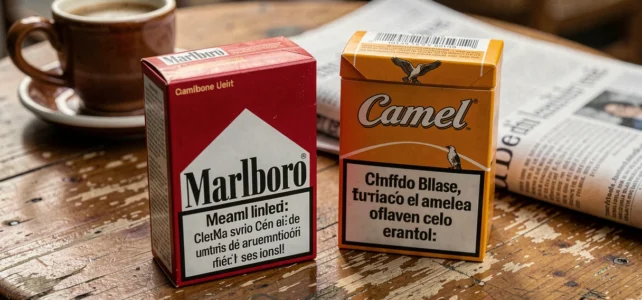
The Commissioner for the Tobacco Market published a new resolution at the end of July 2026, effective immediately. The prices of Marlboro and Camel in Spain do not follow a predictable annual schedule: they change through ad-hoc resolutions from the Ministry of Finance, sometimes multiple times a year. Here we analyze the pricing mechanisms, the observed tariffs, and the points of caution for cross-border buyers.
Tariff Resolutions from the Commissioner: A Misunderstood Mechanism
Tobacco prices in Spain are set by the state and published in the Boletín Oficial del Estado (BOE). Each manufacturer proposes a price, which is then validated by a resolution from the Commissioner for the Tobacco Market. This system is radically different from the French model, where taxation represents almost the entirety of the final price.
The resolution of July 31, 2026, modified the selling prices of over 30 references, covering cigarettes, cigarillos, cigars, and heated tobacco. Price increases do not result from a direct tax hike but from adjustments requested by the manufacturers themselves, within the existing regulatory framework.
For smokers planning a cross-border purchase, this mechanism has a direct consequence: the Marlboro and Camel prices in Spain 2026 can change from month to month without any new tax law being passed. We recommend checking the Commissioner’s website (hacienda.gob.es) before any trip.
Marlboro and Camel Prices in Estancos: Cartons and Formats
The prices in estancos are identical throughout the mainland territory and the Balearic Islands. Whether you buy in Perthus, Madrid, or Valencia, the displayed price should correspond to the current BOE.

Marlboro: Standard and 100’s Formats
The carton of Marlboro Red or Gold (10 packs of 20 units) is around 62.50 euros in Spain, according to the latest surveys. The 100’s formats (long cigarettes) have a slightly lower price, close to 60 euros per carton. The gap with France, where some packs now exceed 13 euros, remains significant.
Camel: The Most Aggressive Price Positioning
Camel remains the cheapest premium brand in Spain, with a carton priced around 51 euros. This translates to a price well below the 6 euro threshold per pack, compared to more than double that on the French side. This pricing strategy explains why Camel is overrepresented in cross-border purchases in Perthus and La Jonquera.
Quick Comparison by Carton
| Brand | Format | Carton (10 packs) |
|---|---|---|
| Marlboro Red/Gold | Standard 20 | ~62.50 € |
| Marlboro 100’s | Long Size | ~60.00 € |
| Camel Filter/Blue | Standard 20 | ~51.00 € |
These prices are those observed during the latest surveys in official estancos. Any variation after a new BOE resolution will render them obsolete.
Spanish Anti-Tobacco Reform of July 2026: Indirect Impact on Prices
The Spanish government approved a major reform of the anti-tobacco law in July 2026. This reform extends smoke-free areas and regulates new products (vaping, heated tobacco, nicotine pouches), but does not contain any measures for a direct tax increase on traditional cigarettes.
The impact on prices is indirect. The tightening of regulations pushes manufacturers to reposition their ranges. New generation products, now subject to a regulatory framework comparable to that of traditional cigarettes, lose part of their competitive advantage. We observe that Philip Morris and JTI are adjusting their pricing structures accordingly, including for Marlboro and Camel.
For French buyers, the key takeaway is that the Spanish regulatory pressure does not (yet) translate into a brutal tax increase. The price gap with France remains substantial, but it is gradually narrowing year by year.
French Customs: Allowed Quantities and Profitability Calculation
European customs regulations set an indicative threshold of four cartons per adult person for cross-border transport for personal use. Beyond that, the burden of proof shifts: it is up to the transporter to demonstrate that the tobacco is not intended for resale.
- Four cartons of Marlboro Red in Perthus represent about 250 euros, compared to more than double for the same quantity in a French tobacco shop
- The cost of the trip (toll, fuel, time) must be included in the calculation: for a round trip from Toulouse or Perpignan, the net savings remain comfortable, but they diminish for trips from Paris or Lyon
- Customs checks focus on the routes Le Perthus – Le Boulou and La Jonquera, with enhanced campaigns during holiday periods
Exceeding the allowed quantities exposes one to confiscation of excess tobacco and fines that can reach several times the value of the goods. The profitability calculation must take this risk into account.

Canaries and Andorra: Different Allowances to Know
The Canary Islands are not part of the EU tax territory for excise duties. The tobacco allowance there is radically different: the return threshold to mainland France drops to 200 cigarettes (one carton). Duty-free prices in the Canaries are lower than on the mainland, but the quantity that can be brought back significantly reduces the economic interest.
Andorra applies an even more restrictive limit for crossing into France: a maximum of 300 cigarettes. Andorran prices remain among the lowest in Europe, but the allowance differential compared to mainland Spain makes the calculation less favorable than it seems.
- Mainland Spain and the Balearic Islands: four cartons (800 cigarettes) per adult
- Canaries: 200 cigarettes (one carton)
- Andorra: 300 cigarettes (one and a half cartons)
The choice of purchase point therefore depends as much on the customs allowance as on the unit price. For Marlboro and Camel, mainland Spain remains the best compromise between price and allowed volume. Before each trip, checking the latest resolutions published in the BOE helps avoid unpleasant surprises regarding the prices displayed in estancos.