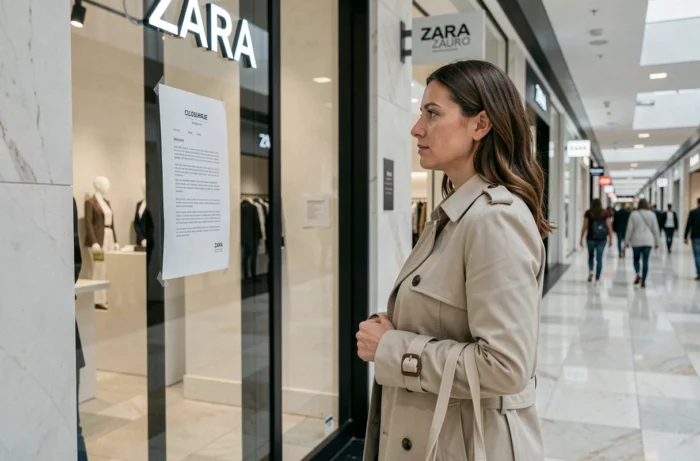
The restructuring of the Zara network in France is not just about stores closing. Inditex is managing a reconfiguration of its retail portfolio where each Zara closure is part of a trade-off between space, profitability per square meter, and cannibalization among the group’s brands. Understanding this movement requires looking beyond local announcements.
Consolidation of the Inditex portfolio: closures and brand transfers
A Zara closure in a French city does not always mean that the Inditex group is withdrawing from the catchment area. In Toulouse, the former Zara Homme location is set to be taken over by Bershka, illustrating an internal reassignment between the group’s brands. The mechanism is well-established: Inditex closes an underperforming store of one brand to install a brand whose price positioning or demographic target aligns better with local foot traffic.
This type of rotation complicates the interpretation of closures. A Zara store that disappears from rue d’Alsace may be replaced by a Stradivarius or a Bershka without the group losing its commercial presence. To follow the upcoming Zara closures to watch, it is essential to distinguish between outright closures (total withdrawal of Inditex) and brand substitutions.
Inditex sometimes invests in former department stores to consolidate several of its brands, indicating a strategy focused on premium locations rather than dispersion across smaller spaces.
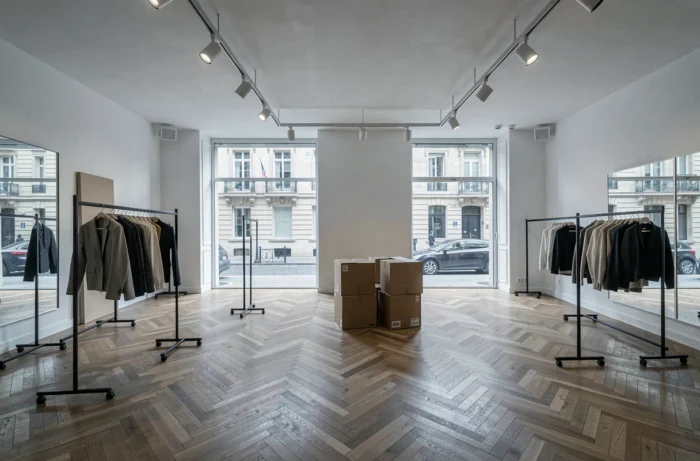
Inditex strategy in France: fewer stores, more retail space
Inditex’s logic rests on an apparent paradox: the number of stores is decreasing, but the total sales area is increasing. The group favors large flagship stores capable of showcasing the entire collections and serving as a showcase for click-and-collect.
This repositioning has direct consequences for medium-sized cities. Zara stores of less than a few hundred square meters, often located in historic city centers with expensive leases, are the first candidates for closure. Major metropolitan areas retain their stores, and even expand them.
Identifiable closure criteria
Several signals can help anticipate the vulnerability of a Zara store:
- Limited sales area, insufficient to display the new men’s, women’s, and children’s collections on a single level
- Immediate proximity to another Inditex store (Massimo Dutti, Pull & Bear) that cannibalizes traffic
- Commercial lease nearing expiration in a context of rising rents in city centers
- Absence of an integrated click-and-collect pickup area, which has become a standard for the group
Cities that combine several of these factors are where the risk of closure is highest by 2026.
Anti-fast fashion law and its real impact on Zara in France
The French law adopted in 2026 against ultra-fast fashion has fueled speculation about a link between regulation and Zara closures. Zara and H&M have been excluded from the scope of this law, which targets platforms producing substantial volumes of new references each week, like Shein.
In practical terms, the regulation does not compel Inditex to modify its physical network in France. The observed closures are due to internal profitability decisions, not legislative pressure. Attributing Zara closures to the fast-fashion law is a shortcut that the available data does not support.
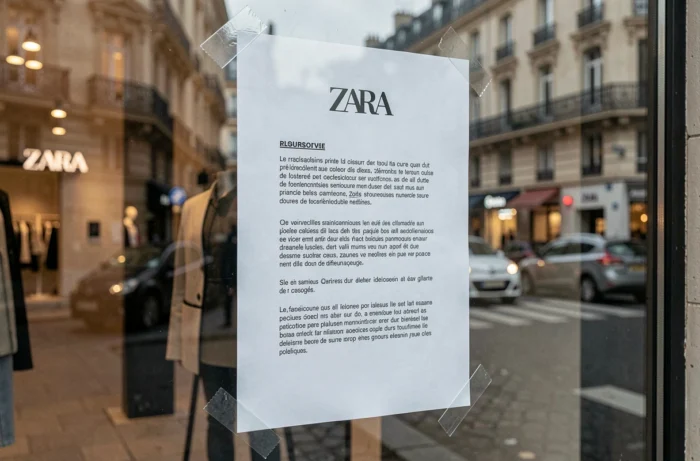
Zara closures and employment: what the announcements do not specify
During the global closure plan announced by Inditex, the group specified that no outright layoffs were planned for the French network. Employees of closed stores are generally reassigned to other points of sale within the group, even under other Inditex brands.
This reassignment policy obviously depends on the density of the Inditex network in the affected area. A Zara employee in Paris or Lyon has more options than an employee in a medium-sized city where the closed store was the only point of sale for the group. The local network determines the social reality behind each closure.
Difference between global announcement and local timeline
Inditex’s press releases announce volumes of closures on a global scale without detailing the timeline city by city. In France, closures are staggered over several quarters and are only confirmed locally a few months before the lease expiration. This opacity makes any definitive list of Zara closures by 2026 necessarily incomplete.
- The most reliable information comes from announcements at city hall or the prefecture, related to changes in commercial leases
- Local retail unions sometimes relay closure plans before the official communication from Inditex
- Commercial court records allow for the identification of early lease terminations
The reconfiguration of the Zara network in France reflects an underlying movement at Inditex: concentrating investments on flagship stores with large spaces, capable of merging physical experience and e-commerce logistics. Medium-sized cities with small Zara boutiques remain the most exposed, while metropolitan areas see their flagships strengthened. Each local announcement deserves to be viewed through this lens before drawing conclusions about the brand’s future in France.