Between high-speed rail and low-cost flights, long-distance buses occupy a unique place in passenger transport. Their cost, carbon footprint and actual onboard comfort vary according to factors that tourist brochures rarely spell out. Comparing these criteria on specific routes helps show what bus travel has to offer—and where it falls short.
Bus emissions compared with trains and cars
Carbon footprint comparisons between modes of transport depend heavily on vehicle occupancy and the scope of the calculation. SNCF’s dataset on emissions by journey notes that estimates vary by mode, route and scope (vehicle use alone, or including manufacturing and maintenance).
When a coach is well occupied, emissions per passenger are significantly lower than those of a private car. Electric trains still have the edge, but the gap narrows when the coach is running at full capacity.
| Mode of transport | Relative emissions per passenger (standard occupancy) | Main variable |
|---|---|---|
| Electric train | Lowest | Country’s energy mix |
| Long-distance coach | Mid-range, close to rail when occupancy is high | Occupancy rate |
| Private car | Highest (especially with the driver travelling alone) | Number of passengers on board |
It is therefore better to compare specific journeys than to rely on general averages. A full Paris–Lyon coach has a different footprint from a half-empty service on a secondary route.
For those looking to discover trips with Voyagenbus, occupancy also affects the price: a full coach helps keep fares low while optimising the journey’s environmental impact.
What comfort is really like on a touring coach: amenities and limitations
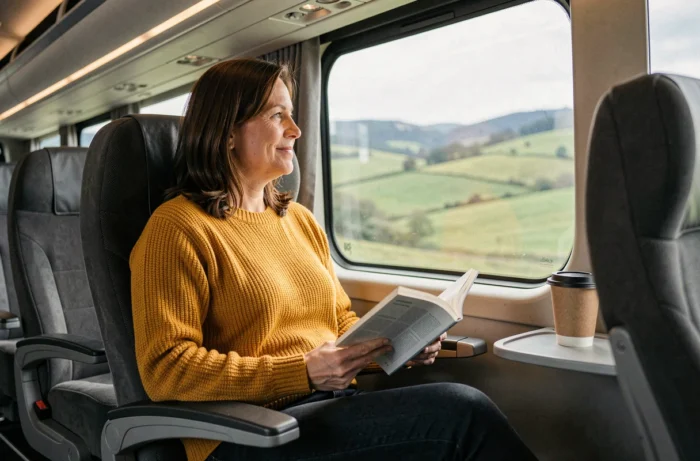
Modern coaches come with amenities that, in some respects, rival first-class rail travel. Reclining seats, power outlets, Wi-Fi and onboard toilets are standard on most long-distance fleets in France and Europe.
Comfort on a coach depends as much on the vehicle model as on the length of the journey.
- For journeys of up to four hours, comfort is comparable to travelling by train, with the added benefit of a route that is often direct and requires no changes
- Beyond six hours, sitting for extended periods and being unable to move around freely become real drawbacks
Coaches are particularly appealing for medium-distance journeys, where the comfort, price and travel time compare favourably with driving and can rival rail on routes with limited train services.
Bus passenger rights: what EU regulations provide
The legal framework for bus travel is less familiar than that for air travel. For regular services covering at least 250 km, EU regulations require passengers to be offered rerouting or a refund in the event of a cancellation or a significant departure delay.
Excursions and organised group trips, however, are covered by a different set of rules. These protections do not apply in the same way to coach tours. For example, an organised trip from Paris to the Loire Valley châteaux or Mont-Saint-Michel is governed by the contract with the tour operator, not directly by the regulations on bus and coach transport.
Digital and physical accessibility since 2025
The European Accessibility Act, which has applied since 28 June 2025, covers online ticketing services and passenger information. Accessibility is no longer limited to the vehicle itself: it also extends to booking, timetables and travel information available online.
This is worth checking before booking, particularly for passengers with reduced mobility. Coach access (high steps, no ramp) varies from one operator to another, and booking platforms do not always display this information clearly.

Bus destinations from France: comparing distances and journey times
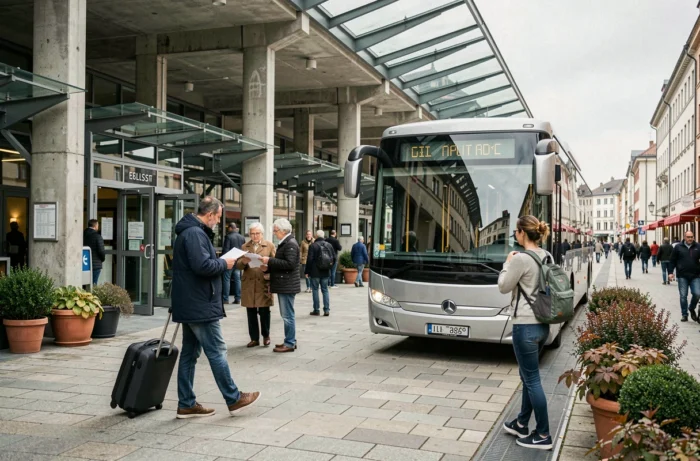
Coach destinations from Paris and other major French cities cover a wide area, from Normandy to Belgium, as well as Provence and northern Spain. Whether the bus is a good choice depends on its journey-time-to-cost ratio compared with the alternatives.
| Destination from Paris | Coach advantage | Rail alternative |
|---|---|---|
| Mont-Saint-Michel | Direct journey with no changes | Train + shuttle (there is no station on site) |
| Bruges | Often cheaper, especially for groups | Train with a change in Lille or Brussels |
| Loire Valley châteaux | Several châteaux visited on one tour | Regional or high-speed train, depending on the château |
| Étretat | Direct journey with no transfers | Train to Le Havre, then a local bus |
For destinations such as Mont-Saint-Michel or Étretat, the coach offers a direct journey where the train requires a change. For Bruges, the train is competitive in terms of journey time, but the bus is often cheaper for group travel.
Group trips and all-inclusive packages
Organised coach trips continue to attract a loyal following, including associations, works councils and senior clubs. All-inclusive packages (transport, accommodation and guided tours) simplify logistics, especially for groups of twenty or more.
The cost per person falls as the group grows, making coaches particularly well suited to group getaways of two to four days in France or neighbouring countries.
Bus travel should be assessed using concrete criteria: emissions per passenger-kilometre, door-to-door journey time and passenger rights if something goes wrong. For medium-distance journeys and routes with limited rail services, coaches remain a good-value option, provided you check occupancy rates and the transport operator’s terms before booking.