
A reusable cup bearing a company logo is not a gadget. It is a communication tool that circulates from hand to hand, is washed, reused, and remains visible long after the event where it was distributed. The customized cup combines three functions in a single object: functional container, advertising vector, and proof of environmental commitment.
Since the implementation of the REP “restaurant packaging” system in France on March 15, 2024, companies distributing food containers must integrate the logic of reuse into their compliance. This regulatory constraint transforms the customized cup from a promotional accessory into a strategic tool, provided the rules of the game are mastered.
Regulatory compliance of the customized cup: REP, PPWR, and environmental claims
The European packaging regulation (PPWR) came into effect on August 12, 2026. It requires companies to have enhanced traceability of reusable packaging, including those used in events and catering. Customized cups distributed at festivals or trade shows fall directly within this scope.
At the same time, the REP “restaurant packaging” system requires affected companies to declare certain major references of food packaging to their eco-organization. In practical terms, a reusable cup bearing your logo must be able to justify its lifecycle: number of planned reuses, collection system, material used.
Environmental claims are also under scrutiny. Claiming that a cup is “eco-friendly” or “compostable” without tangible proof exposes one to sanctions. In the UK, the Digital Markets, Competition and Consumers Act 2024 has required since April 2025 that environmental promises be clear, precise, and justified. The trend is similar in Europe.
For a brand, this demand for transparency represents a credibility lever. A reusable cup with documented compliance sends a stronger message than a simple logo printed on disposable plastic. Exploring original communication solutions now requires this regulatory rigor as much as graphic creativity.
Reusable cup as a brand support: what works on the ground
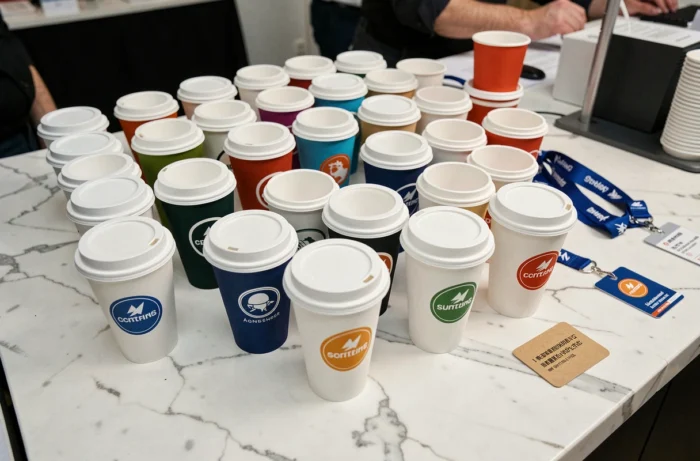
Field feedback confirms that reuse works when the user experience is well designed. A benchmark conducted in 2026 on events and stadiums shows a very high satisfaction among audiences regarding reusable cup systems. The identified points for improvement focus on signage and the visibility of return stations, not on the principle itself.
This finding has a direct implication for customization. Branding on a reusable cup is not limited to the logo. It can include practical information (return point, deposit, QR code to a loyalty program) that enhances the experience while reinforcing brand presence.
Criteria for effective branding on reusable cups
- The printable area must remain legible after several dozen washes. Branding that fades after a few uses harms the brand image instead of serving it
- The design must include at least one functional element (return deposit, sorting pictogram) in addition to the logo, to justify the reuse claim
- The choice of material affects perceived quality: a cup that is too soft or too light will be discarded like a disposable one, negating the lasting advertising effect
- The background color of the cup influences the readability of the logo. A light background with dark branding remains the most visible combination in real conditions (festival lighting, artificial light at trade shows)
The goal is for the cup to be kept and reused daily. A cup kept at home generates brand impressions over several months, whereas a flyer ends up in the trash the same day.
Integrating the customized cup into a global communication strategy
The customized cup gains its full value when it is part of a coherent system. Distributed alone, without context, it remains just another promotional item. Associated with a campaign, it becomes a physical touchpoint that extends a digital or event message.
Three concrete integration scenarios
At a trade show, the cup replaces the traditional fabric bag as a welcome goodie. It is more compact, more useful in daily life, and less mundane. The branding can include a campaign hashtag or a short link to a dedicated landing page.
At internal events (seminar, team building), the customized cup in the company’s colors serves a dual purpose: waste reduction and strengthening the sense of belonging. Employees who leave with their cup extend the visibility of the employer brand in their personal environment.
At points of sale or in catering, switching to a personalized reusable cup directly addresses the obligations of the REP system. Customization transforms a logistical constraint into a communication opportunity, provided the collection and washing system is clearly organized.
Cost and durability of the reusable promotional cup: balancing unit price and impact
The unit cost of a personalized reusable cup is significantly higher than that of a disposable cup. This price difference is justified by the number of reuses and the prolonged exposure of the brand.
The decision is not made solely on the purchase price. It is necessary to factor in the costs of collection, washing, and storage between events. A poorly designed reuse program costs more than a disposable and gives an image of disorganization.
- Plan for a realistic loss rate: some cups will not be returned, which is normal and even desirable (the kept cup remains an active advertising medium)
- Negotiate with a certified washing service provider to ensure sanitary compliance and be able to document the reuse cycle in light of REP obligations
- Adjust the quantity ordered to the actual number of participants, not to an optimistic estimate. An unused surplus represents a cost without return
The personalized reusable cup sits at the intersection of communication, environmental compliance, and event logistics. Brands that make the most of this item are those that address these three dimensions together, not separately. Regulation only reinforces this demand for coherence.