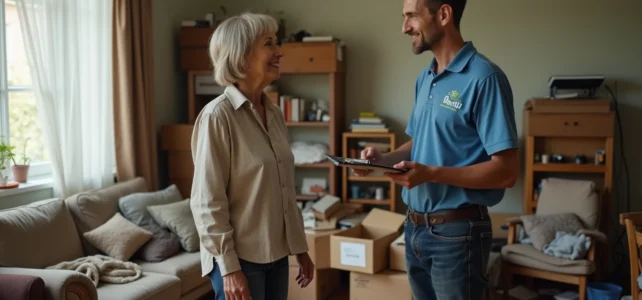
Calling on an association to empty a house after a death, a move, or simply for decluttering seems like a straightforward process. The principle: volunteers or employees in reintegration collect your furniture, items, and bulky waste, resell or redistribute what has value, and dispose of the rest. In practice, not all organizations operate the same way, and some may not be able to handle a complete home.
Chronotachograph and utility vehicles: a constraint reshaping the associative landscape
Since July 1, 2026, light utility vehicles exceeding a maximum authorized weight of 2.5 tons must be equipped with a chronotachograph to circulate within the European Union. This requirement, which also applies to moving and clearance activities, changes the game for associations with large-capacity trucks.
In concrete terms, organizations using vans above this threshold must now manage driving time tracking, train their drivers, and be subject to inspections. This represents a cost and an administrative burden that small local associations, equipped with lighter vans, do not have to bear.
This criterion should be addressed from the first contact. An association operating with a vehicle below the 2.5-ton threshold will have different logistical constraints (multiple trips for a whole house, for example), but often greater organizational flexibility.
Conversely, an organization with large vehicles can remove everything in one go, but its operating costs will be higher, which may affect the conditions of service free of charge. To compare these models, you can check useful information on Maisons et Conseils before requesting a quote.
Waste disposal, reuse, and association: who takes care of what during a house clearance
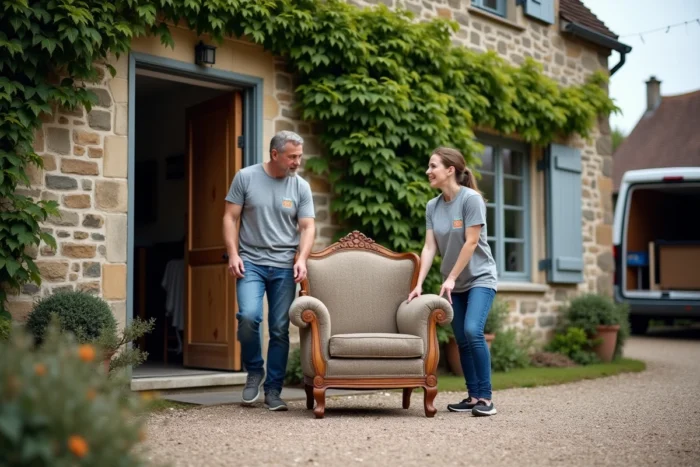
One point that many individuals discover too late: no association takes care of the entire contents of a home. Reusable items (furniture in good condition, functional appliances, dishes, knick-knacks) are at the heart of their activity. However, used mattresses, waste from non-functional electrical equipment, rubble, or chemical products fall under other channels.
Public waste disposal sites remain reserved for individuals and impose volume limits, restrictions on the types of waste accepted, and sometimes specific access conditions for each community. An association does not replace a waste disposal site, and vice versa.
Before contacting an organization, it is useful to quickly inventory the home by distinguishing three categories:
- Reusable items (furniture, clothing, books, small functional appliances) that the association can collect and value
- Non-reusable bulky items (mattresses, heavily damaged sofas, treated wood) that require a trip to the waste disposal site or removal by the municipal service
- Specific waste (paints, solvents, non-functional electronic equipment) subject to dedicated collection channels, often managed by eco-organizations
This prior sorting avoids misunderstandings on the day of the intervention and allows for comparing quotes on a realistic basis. The exact scope of the service determines the final cost, including when the association announces a free service.
Free service from an association: the real conditions to check
The free service of a clearance by an association relies on a simple balance: the resale value of the collected items must cover the intervention costs (labor, fuel, disposal of unsellable items). When a home contains enough furniture, appliances, or knick-knacks in good condition, the operation can indeed cost nothing to the individual.
On the other hand, when the contents are mostly made up of waste, broken items, or furniture without market value, most associations charge an additional fee. This fee covers disposal at the waste site and the work time not compensated by resale.
Questions to ask before signing
The quote must specify what is included and what is not. A few points to clarify systematically:
- Does the association take care of non-reusable bulky items, and if so, at what additional rate?
- Are the collected items resold, donated, or redistributed to identified beneficiaries?
- Does the intervention include a basic cleaning of the emptied rooms, or only the removal of items?
- Is the transport handled by the association itself or subcontracted to a private provider?
This last question is not trivial. Some associations rely on traditional clearance companies for large volumes, which alters both the cost and the guarantees (insurance, liability in case of damage in the home).

Finding a local clearance association: beyond online directories
Directory platforms (PagesJaunes, AlloVoisins) indiscriminately mix commercial enterprises and associative structures. Identifying a genuine association with a social or solidarity purpose requires a bit more research.
Resource centers and recycling centers, often affiliated with the national network of resource centers, constitute a reliable first filter. These structures have accreditation, a transparent economic model based on reuse, and verifiable local presence. Emmaüs, associations for economic reintegration, and some branches of the Red Cross also offer home collection services, with varying conditions depending on the territories.
Word of mouth remains the most reliable channel for assessing the quality of an intervention. Town halls and communal social action centers (CCAS) regularly direct residents to local associations whose actual operations they know. This institutional relay offers a form of guarantee that online reviews, which can sometimes be manipulated, do not provide.
One last point to keep in mind: the intervention times vary significantly from one organization to another. Associations operating with volunteers have more constrained schedules than businesses. If the home needs to be emptied quickly (end of lease, ongoing sale), this factor weighs as much as the price in the final choice.