
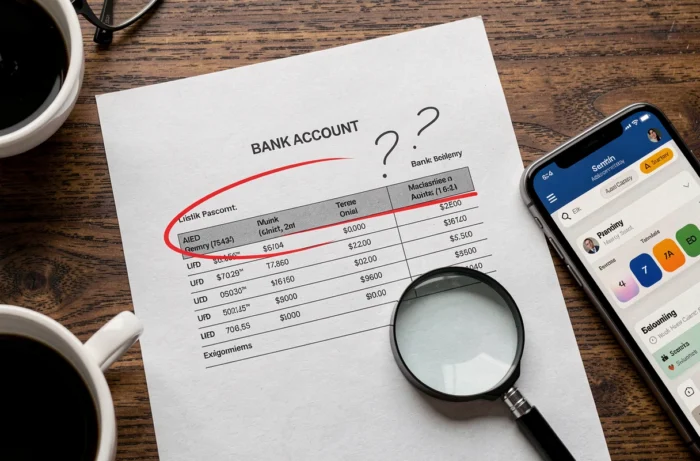
One morning, while reviewing your bank statement, you spot a line “IMPRIMERIE NATIO FLERS EN ESCRE” for an amount you do not recognize. The description is truncated, and the amount does not match anything in your purchase memories. This Natio printing withdrawal on your bank statement triggers a legitimate reflex: you immediately wonder if you are a victim of fraud.
Check the details of the SEPA withdrawal before taking any action
The first reflex to adopt is not to contact the bank by phone, but to open the details of the transaction in your online banking space. This is where the information that makes the difference between a forgotten authorized withdrawal and a real fraud can be found.
In the details of each SEPA withdrawal, the bank displays the ICS code (SEPA Creditor Identifier) of the issuer. This code is unique for each organization authorized to issue withdrawals. By comparing it with the official information from the Imprimerie Nationale, you can confirm or rule out the authenticity of the transaction.
The description “IMPRIMERIE NATIO FLERS EN ESCRE” generally refers to the Imprimerie Nationale, one of whose production sites is located in Flers-en-Escrebieux, in the North. If you have ordered a passport, a residence permit, or another official document in recent months, there is a good chance that this withdrawal is legitimate. Many account holders do not make the connection between an administrative procedure and this truncated bank description.
When trying to understand a Natio printing withdrawal on a bank statement, checking the ICS code and the exact amount remains the quickest way to decide.

SEPA withdrawal fraud: why cases are increasing
The current context makes distrust understandable. According to the Payment Means Security Observatory (Banque de France), the amount defrauded on SEPA withdrawals reached approximately 23.8 million euros in the first half of 2025, representing an increase of about 37% in one year. Unusual withdrawals are increasingly exploited as a vector for fraud.
The dominant technique is no longer simple technical hacking. Fraud by manipulation (fake bank advisor, identity theft of an organization) now accounts for 41.6% of total payment fraud, up 34% year-on-year. In practice, fraudsters can impersonate the name of a legitimate creditor to issue a withdrawal or push a victim to validate a SEPA mandate without them understanding its implications.
What complicates detection: a truncated bank description looks like another. “IMP NATIONALE FLERS” can be a legitimate withdrawal from the Imprimerie Nationale or an attempted impersonation. The description alone is never enough to conclude.
Verify the legitimacy of an Imprimerie Nationale withdrawal: concrete steps
Before disputing anything, go through a series of quick checks. Here are the points to verify:
- The ICS code of the creditor, visible in the transaction details online. If it matches that of the Imprimerie Nationale, the withdrawal is authentic.
- The amount: compare it to the price of the official document you may have ordered (biometric passport, national identity card, residence permit). Feedback varies on this point, as some additional fees may slightly alter the total.
- The date of the SEPA mandate: check if you signed a withdrawal mandate during an online procedure on an official site (ANTS, prefecture).
- The unique mandate reference (RUM), also displayed in the withdrawal details. It allows you to find the exact transaction in your exchanges with the administration.
If any of these elements do not match (unknown ICS code, inconsistent amount, no recent administrative procedure), you can proceed to dispute.
Disputing an unauthorized withdrawal: deadlines and banking procedure
The SEPA regulation provides for two distinct dispute windows, and the difference between the two changes everything.
For an authorized withdrawal that you wish to dispute (incorrect amount, duplicate), the deadline is 8 weeks after the debit date. Your bank must refund you without requiring proof, as it is an automatic right.
For an unauthorized withdrawal (no signed mandate, unknown creditor), the deadline extends to 13 months. In this case, you must report the transaction as fraudulent to your bank, which must refund the debited amount.
In parallel, if the withdrawal is linked to fraudulent use of your banking details, you report the transaction on the Perceval platform of the Ministry of the Interior. This reporting facilitates prosecution and strengthens your case with the bank.
What to do if the bank refuses the refund
Some institutions delay or dispute the fraudulent nature of the transaction. In this case, you should contact the banking mediator by registered mail. The mediator has a legal deadline to provide an opinion.
If this route fails, there remains the possibility of taking the competent court. But in the vast majority of cases, quick reporting (within 8 weeks or 13 months depending on the situation) is sufficient to obtain a refund.
Natio printing withdrawal: how to avoid confusion in the future
The real problem behind these alerts remains the format of bank descriptions. SEPA descriptions are often truncated to 30 or 35 characters, making the names of official creditors unrecognizable.
- Always note the reference of the SEPA mandate when you carry out an administrative procedure involving a payment.
- Activate withdrawal alerts in your banking app to be notified in real-time.
- Keep the payment confirmations sent by official sites (ANTS, prefectures): they mention the exact amount and the expected debit date.
A withdrawal “IMPRIMERIE NATIO” is not a scam in most cases. It is the truncated format of the description that creates concern, not the operation itself. Checking the ICS code in the transaction details remains the most reliable action to distinguish a legitimate debit from an attempted fraud.