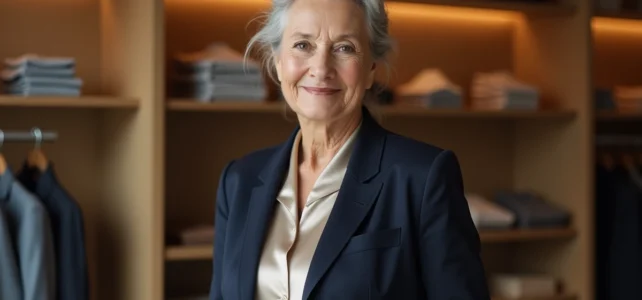
At 75, most women know what suits them. The problem is not a lack of taste, but often a lack of appropriate references. Magazines cater to thirty-somethings, the shelves offer standardized cuts, and fashion advice revolves around the same basics without considering the physical realities of daily life.
Building a wardrobe at this age means making specific choices about materials, cuts, and colors that serve both comfort and style.
Materials and Cuts that Respect the Body After 75
You may have noticed that a garment worn for ten minutes in a fitting room can become a torture after two hours? At 75, tolerance for rigid fabrics, poorly placed seams, or overly tight belts decreases. The choice of material takes precedence over color or cut.
Natural fibers like combed cotton, washed linen, or fine merino wool offer breathability that polyester cannot match. For transitional seasons, a cotton-modal blend provides flexibility without a “sloppy” effect.
Favoring soft fabrics with a structured drape allows for shaping the silhouette without constricting. A lightweight crepe jacket, for example, sits better on the shoulders than a thick tweed blazer while remaining easy to slip on. Details matter: slightly wider armholes, magnetic closures instead of tiny buttons, and pants with a hidden elastic waistband under a pleat.
For those seeking concrete inspirations suitable for this age, the suggestions for looks and women’s clothing for 75-year-olds on Modeste Fashion illustrate this balance between comfort and elegance well.
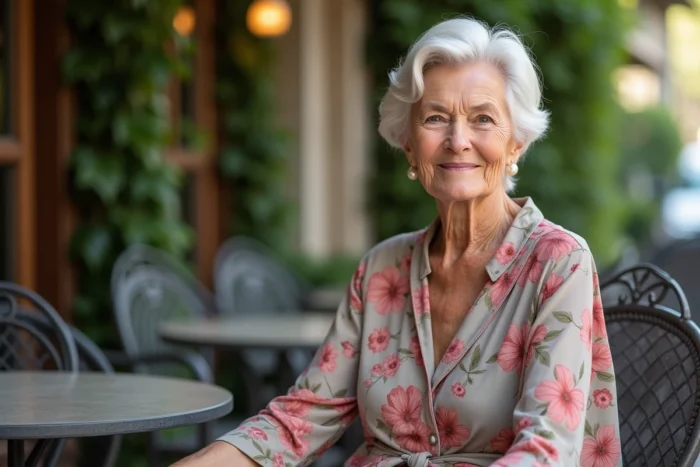
Sustainable Wardrobe at 75: Fewer Pieces, More Outfits
Accumulating clothes has never made anyone more elegant. At 75, the opposite works better: a streamlined wardrobe centered around versatile pieces simplifies daily life. Every morning in front of the wardrobe becomes smoother when everything combines with everything.
The principle is based on a coherent color foundation. Not a uniform, but a personal palette built around two or three neutrals (navy, heather gray, beige, off-white) and two more assertive colors.
Colors that Add Depth Without Tiring the Complexion
All-black outfits tend to harden features after a certain age. Deep burgundy, emerald green, or a petrol blue provide the same sobriety with more brightness near the face. A scarf in one of these shades placed over a neutral top radically changes the overall effect.
“Jewel” tones advantageously replace black for dressy occasions. A straight burgundy crepe dress worn with gold earrings is enough to create a ceremonial outfit without overloading.
The Capsule Wardrobe Adapted to the Seasons
Here’s a concrete base that covers most daily situations:
- Two pairs of straight or slightly flared trousers, one in canvas, the other in fine wool, in compatible neutral shades
- Three tops of different textures (a cotton blouse, a round-neck merino sweater, a fluid jersey top) in complementary colors
- A lightweight, structured jacket, like a casual blazer or linen jacket, that works well over jeans or a dress
- A mid-length dress with three-quarter sleeves, simple enough to accommodate different accessories depending on the context
- A quality coat or parka, purchased to last several seasons
With these pieces, you can easily create about fifteen different combinations. The investment focuses on the quality of the fabric and the precision of the cut rather than on quantity.
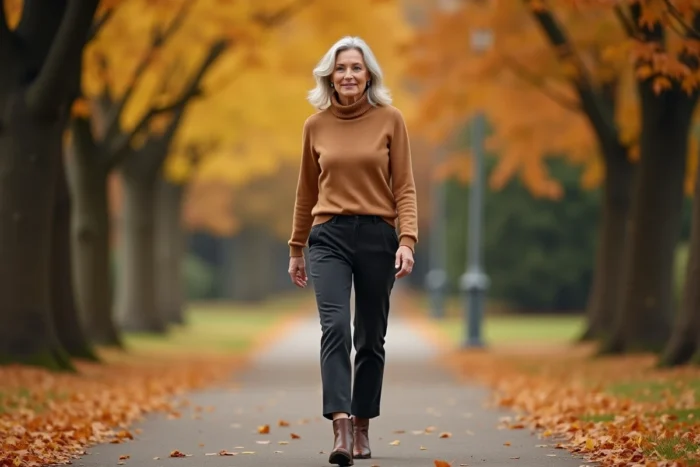
Accessories and Silhouette: The Details That Change a Woman’s Outfit at 75
Accessories play a more significant role after 70 than at any other time in life. When the wardrobe simplifies, they bring personality.
A well-chosen piece of jewelry is worth more than three stacked trends. A short pearl necklace, a brooch on the lapel of a jacket, or a cuff bracelet is enough to define a style. The trap would be to wear everything at once. One focal point per outfit gives more strength to the whole.
The bag also deserves attention. An adjustable crossbody model, light enough not to pull on the shoulder, with an easy-to-manipulate opening. A structured shape (like a satchel or bucket bag) holds up better over time than a soft bag that collapses.
Comfortable and Elegant Shoes After 70
Feet change with age: they widen, and pressure points shift. Wearing heels over four centimeters becomes risky for balance. However, a small block heel of two to three centimeters elongates the silhouette without compromising stability.
Soft leather loafers, ankle boots with side zippers, or lightweight derbies cover most uses. Comfort is verified as soon as you try them on: if the shoe pinches anywhere, no “breaking in” will fix the problem.
Anti-Fast Fashion Law and Sustainable Fashion: What Changes for Shopping
The anti-fast fashion law definitively adopted in France provides for an environmental penalty per product and a ban on advertising for ultra-fast fashion brands. This regulatory framework encourages retailers to make information about the sustainability of clothing visible.
For a 75-year-old woman, this evolution confirms what experience has long taught: buying less but better protects both the wallet and the planet. Second-hand shopping, customizing an existing piece (shortening pants, changing buttons on a coat), or using a local tailor become style reflexes as well as economical gestures.
Building a wardrobe at 75 requires neither a huge budget nor constant fashion monitoring. About ten well-cut pieces in pleasant materials, a controlled color palette, and a few carefully chosen accessories are enough to create elegant outfits for every occasion. The real luxury at this age is never having to wear something that itches, constricts, or doesn’t resemble the person wearing it.