
Renewing a prescription from your couch, monitoring your blood sugar without going to the office, getting a dermatological opinion in less than an hour: we can do all this today with a smartphone and an internet connection. Online health monitoring is no longer limited to occasional teleconsultations. Between telemonitoring reimbursed by Health Insurance, prevention applications, and digital medical devices regulated by law, the possibilities have become more structured in recent years.
Reimbursed medical telemonitoring: what the transition to common law changes concretely
There is a lot of talk about teleconsultation, but medical telemonitoring remains less known even though it profoundly changes the daily lives of chronic patients. Since July 1, 2023, this practice is reimbursed under common law by Health Insurance, with a monthly fee dedicated to the healthcare team and coverage for the digital device used.
In practice, one wears a sensor or uses a certified application that automatically transmits data (blood pressure, oxygen saturation, blood sugar) to a healthcare professional. They intervene remotely if an alert threshold is crossed. One only goes to the office when it is medically justified.
The framework is strict. Telemonitoring is limited to certain pathologies: heart failure, respiratory failure, kidney failure, diabetes, oncology, cardiac arrhythmia, and implantable cardiac prostheses. The establishment or professional must make a prior declaration to the ARS, otherwise no reimbursement is possible. The digital device must hold a certificate of compliance issued by the Health Digital Agency.
For the patients involved, the difference is tangible: fewer trips, increased responsiveness in case of decompensation, and monitoring that no longer relies solely on the quarterly visit. Feedback varies on this point, with some patients appreciating the gained autonomy while others regret the loss of direct contact with the caregiver.
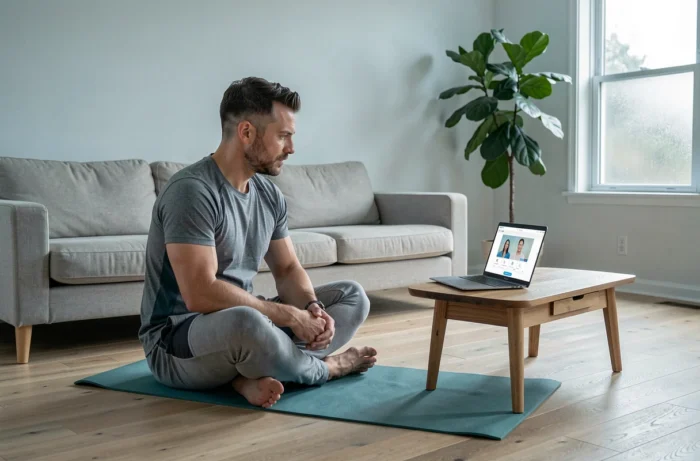
Online health in daily life: distinguishing prevention, monitoring, and emergencies
We often mix three very different uses under the label “online health.” Clearly separating them helps to choose the right tools and not to expect from an application what it cannot offer. Among the resources that centralize these approaches, the Wype health website gathers useful information to guide according to one’s actual needs.
Prevention and well-being
This is the realm of consumer applications: scanning a food product to check its composition, tracking sleep cycles, practicing guided meditation. These tools are not medical devices. They do not have any specific regulatory obligation regarding the clinical reliability of their data. There is nothing to prevent using them to improve habits, as long as one does not entrust them with a diagnostic role.
Remote medical monitoring
We enter here into the regulated domain. Digital medical devices (DMDs) used in telemonitoring go through a certification process. Their reimbursement requires a clinical evaluation and compliance with interoperability and security standards.
The distinction has concrete consequences. A wellness application can disappear overnight or change its algorithm without notice. A certified DMD must maintain a level of reliability certified by the Health Digital Agency.
Emergency and guidance
Teleconsultation allows for a quick opinion for non-urgent situations. For chest pain or loss of consciousness, one calls 15. No online platform replaces an emergency service.
Health data and GDPR: reflexes to adopt before signing up
When creating an account on a health platform, one transmits data classified as sensitive under the GDPR. Most users accept the general terms without reading them, and this is precisely where the problems begin.
Before entrusting one’s medical history to an application, one should check a few concrete points:
- Data hosting must be HDS certified (Health Data Host). Without this certification, a provider is legally not allowed to store personal health data in France.
- The privacy policy must specify whether the data is sold or shared with third parties for commercial purposes. A free application that does not mention anything on this point is likely monetizing your information.
- The right to deletion must be effective. One should be able to request the complete deletion of their account and the associated medical history, and receive confirmation within a reasonable time.
My Health Space, the public service launched by Health Insurance and the Ministry of Health, offers a guaranteed framework on these aspects. The data is hosted on certified servers, and the patient retains control over the access granted to healthcare professionals.
Teleconsultation: practical limits and actual reimbursement
Teleconsultation has become commonplace, but some constraints persist. Reimbursement by Health Insurance is subject to conditions: the patient must have consulted the teleconsulting doctor at least once in person in the previous twelve months, except for exceptions (difficult access, relative emergency).
Clinically, a screen does not replace palpation or auscultation. Doctors themselves refer to a physical consultation as soon as the situation justifies it. Teleconsultation works well for renewing a prescription, simple post-operative follow-up, or a dermatological question accompanied by clear photos.
There are also disparities in the quality of platforms. Some guarantee a doctor available in a few minutes, while others have waiting times comparable to those of a traditional office. The criterion to check remains the presence of doctors registered with the Order of Physicians and transparency regarding the coordinated care pathway.
Online health monitoring is gaining reliability as the regulatory framework strengthens. Reimbursed telemonitoring, certified digital medical devices, and GDPR requirements on sensitive data create a more structured landscape than a few years ago. It remains for each individual to verify, before clicking, whether the chosen tool falls within the regulated medical field or in the realm of well-being without clinical guarantees.