
You are in front of your property, the remote control triggers nothing, and the gate remains stuck. Before forcing anything, it’s important to understand one key point: this blockage is not a malfunction. Most recent residential motors are said to be irreversible, meaning they lock themselves intentionally in the absence of power. This is a safety feature designed to prevent any intrusion.
The manual disengagement by key is then the only access method provided.
Irreversible motorization and intentional locking: what the blockage really means
According to a guide published by FA2P, locking in the event of a power outage is the default norm in individual residential settings. The motor keeps the gate closed through a mechanical system that does not release on its own when power returns.
This design has concrete implications. First, one cannot simply push an irreversible gate without disengaging the mechanism, risking damage to the motor or the arms. Secondly, this locking protects against vandalism and intrusion, which can affect insurance matters if you leave the gate open after manual handling.
The reflex to have: never force it. First, locate the disengagement system, then follow the procedure specific to your motorization. Understanding the disengagement of an electric gate in detail allows for intervention without stress and without damage.
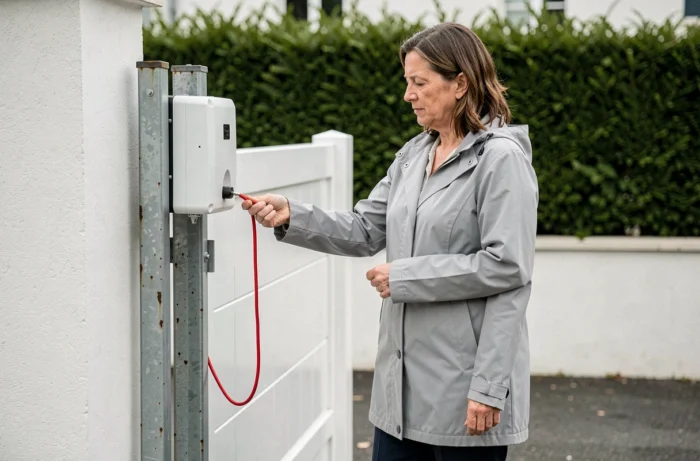
Disengaging the malfunctioning gate: locate and operate the mechanism
The disengagement system varies depending on the type of gate. On a sliding gate, there is usually a button or lever directly on the motor housing. On a swinging gate with arm or cylinder motorization, the disengagement may be located on each motor attached to the leaves.
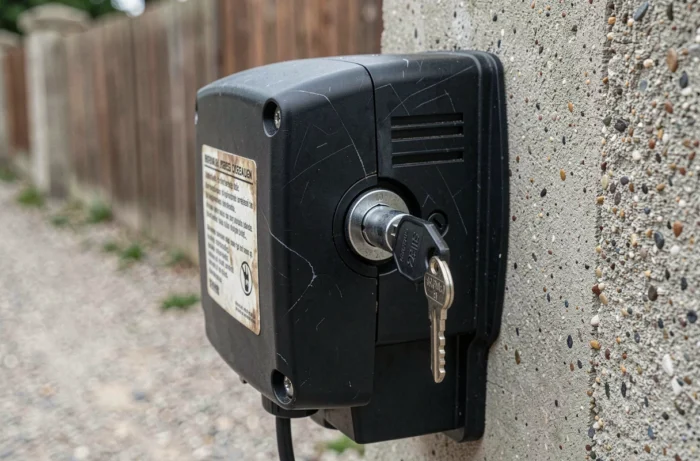
Unlocking key and external cylinder
Most motorizations come with a triangular key or a flat key cylinder. By default, this system is often accessible only from inside the property, for anti-intrusion security reasons.
If you are stuck outside, this is a real problem. Brands like Came or Nice offer an optional external unlocking cylinder installed on the pillar or housing. Without this option, you will need to go through a secondary access (pedestrian gate, garage, service door) to reach the mechanism from the inside.
Concrete manipulation of the disengagement
Once in front of the motor, the procedure remains simple in most cases:
- Insert the unlocking key into the motor lock and turn a quarter turn. A click confirms that the mechanism is released.
- Push or slide the gate manually, slowly, checking that nothing obstructs the rail or the movement of the leaves.
- Bring the gate to a fully open or fully closed position. Never leave it halfway.
- Once power is restored, return the button or key to the locked position before restarting the motorization.
Feedback on this point varies by model: some motors automatically re-engage the motorized mode when power returns, while others require manual intervention. Consult your motorization manual.
Power cut during movement: the case that no one details
The most delicate situation occurs when the power cut happens while the gate is moving. The leaf or sliding panel stops halfway, in an unstable position. An ajar swinging gate can be caught by the wind and twist the motorization arms.
In this specific case, it is necessary to disengage immediately and bring the gate to a stop (open or closed). Leaving it halfway exposes the mechanical joints to unforeseen stresses and complicates the recalibration of the motor once power is restored.
On encoder motorizations, a stop halfway can also shift the recorded end-of-travel positions. When power returns, the motor tries to return to its reference position and may force against the stops. A manual recalibration (resetting the end-of-travel positions) will then be necessary.
Backup battery and external cylinder: anticipate the next failure
Manually disengaging a gate remains a temporary solution. To avoid getting stuck repeatedly, two pieces of equipment really change the game.
The backup battery connects to the motor’s electronic board. It takes over as soon as the mains power goes out, allowing the gate to operate normally for several opening and closing cycles. The duration of autonomy depends on the model and the battery capacity, but it generally allows for several hours of intermittent operation.
The external unlocking cylinder does not resolve the failure: it simply allows access to the disengagement without having to circumvent the property. It is a comfort element that avoids absurd situations where you are in front of your gate with the unlocking key, but the mechanism is on the other side of the wall.
What we recommend as a priority
- Install an external cylinder as soon as the motorization is installed, especially if the property does not have an independent pedestrian gate.
- Plan for a backup battery compatible with your motorization. Check compatibility with the electronic board before purchasing.
- Test the manual disengagement at least once a year to ensure that the lock is not stuck and that the key is accessible.
A well-equipped electric gate turns a power outage into a non-event. Without a battery or external access to disengagement, the same outage becomes a hassle that may require professional intervention. The choice is made at the time of installation, not on the evening when the power goes out.