When a collective of queer artists organizes a drawing workshop in a former commercial space in Paris converted into a third place, we are far from the institutional vernissage. This type of programming, carried by lightweight and often precarious structures, is reshaping the alternative art scene in France. The venues are multiplying, the formats are intersecting, and public funding is contracting. Here’s what is concretely changing in 2026.
Cultural third places: the alternative network that structures the scene
The alternative scene is often described as a diffuse movement. In reality, it relies on an increasingly visible infrastructure: third places. In 2026, approximately 4,050 third places are recorded in France, compared to 3,500 in 2023 and 1,800 in 2018.
The significant fact is the role that culture occupies in these spaces. 70% of them develop cultural or artistic programming, and nearly 62% regularly host events open to the public. In 2025, these places organized more than 234,000 events with an estimated attendance of 10 million participants.
They are neither galleries nor performance venues in the traditional sense. Industrial wastelands, former shops, rehabilitated farms: these hybrid spaces mix coworking, creative workshops, artist residencies, and musical or visual programming. For those looking to explore the Rockette Libre site, this type of resource allows for the identification of local initiatives often absent from traditional media radars.
This decentralization changes the game. An artist exhibiting in a third place in Dijon or Nantes reaches a different audience than that of Parisian galleries, with distinct mediation and access codes.
Cabaret Season 2026: when the ministry recognizes alternative scenes
The first Cabaret Season, announced by the Ministry of Culture in the fall of 2025, started on September 18, 2026. This national label marks a milestone for artistic forms long considered minor or marginal.
Contemporary cabaret is not limited to music hall. It includes drag, queer performance, circus, spoken word, and multidisciplinary creations. This Cabaret Season explicitly includes queer and alternative scenes, which constitutes unprecedented institutional recognition for these practices.
The stakes are twofold. On one hand, increased visibility for artists working outside conventional circuits. On the other, a risk of institutionalization that could smooth out what makes these proposals strong: their raw, spontaneous, and sometimes uncomfortable character.
Hybrid formats and live performance
The trend towards hybrid formats is not limited to cabaret. Live performance as a whole is increasingly integrating digital elements, real-time video, and immersive devices. Companies are creating pieces that combine physical performance and interactive projection, blurring the boundary between visual arts and performing arts.
Reactions on this point vary: some collectives see it as a renewal of the relationship with the audience, while others view it as a race for technical equipment that is difficult to reconcile with tight budgets.
Decrease in subsidies: what it concretely changes for artists
One cannot talk about the alternative scene without addressing the budgetary issue. Cuts in subsidies hit the most fragile structures hard, those that carry the least formatted proposals.
- Independent live performance companies see their funding reduced or frozen, which delays creations or cancels tours.
- Intermediate venues (wastelands, legalized squats, self-managed spaces) sometimes lose their funding agreements without alternative financing.
- Emerging artists, who depend on residencies and grants to produce, find themselves in increased competition for smaller budgets.
The existence of alternative contemporary art is threatened at its very core, to use a phrase circulating in the field. Private patronage does not compensate, as alternative structures lack the notoriety and networks to attract sponsors.
In practice, this pushes towards two strategies: mutualization (sharing spaces, equipment, administrative skills) and crowdfunding, which works for one-off projects but does not replace structural support.
Queer art and engaged collectives: increasing visibility on the French scene
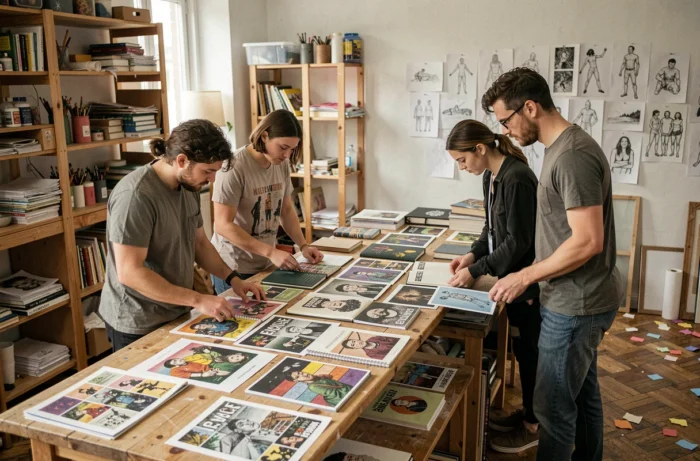
Queer art occupies an increasingly visible place in the French alternative programming. From queer drawing workshops like those organized at Cesure in Paris to the Incandescent·e·s evenings at Bellevilloise, these proposals blend artistic creation and political advocacy.
What distinguishes these initiatives is their community grounding. We are not talking about works produced for an art market or an institutional exhibition. We are talking about collective practices where the process matters as much as the result: open workshops, participatory performances, self-published publications.
Minorities and engaged artistic creation
The issue extends beyond the queer field. More broadly, the place of minorities in engaged artistic creation is receiving increasing attention. Afro-descendant collectives, artists with disabilities, and creators from recent immigration are investing these alternative spaces because they find a freedom of form and discourse absent from institutions.
This diversification of voices does not come without tensions. Questions of legitimacy, appropriation, and representation run through the collectives themselves, with sometimes heated debates about who speaks, for whom, and in what context.
Independent music and the alternative scene: increasingly common bridges
The boundary between visual arts and independent music is blurring in alternative programming. The same venue can host a silkscreen exhibition on Saturday afternoon and a French reggae concert in the evening. This porosity between disciplines is one of the strong characteristics of the current scene.
Artists navigate between music production, visual performance, and installation, without worrying about the categories of the art world or the music industry.
These bridges between disciplines attract an audience that does not frequent museums and discovers contemporary creation through music, graffiti, or video. It is a parallel distribution circuit, less documented but very active, that contributes to renewing the audience for culture in France.
The French alternative artistic scene is not lacking in energy or proposals. What it lacks are stable resources and media coverage commensurate with what it produces. Third places are multiplying, formats are being reinvented, and voices are diversifying. It remains to be seen whether public authorities will follow the movement or if these dynamics will continue to rely on resourcefulness and volunteer engagement.