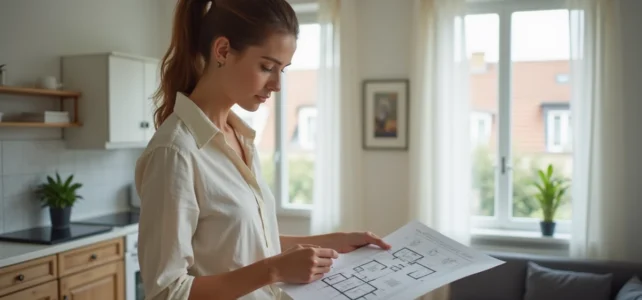
The F2 designation refers to a two-room apartment classified by its function, while T2 refers to the same layout classified by its type. F2 and T2 describe exactly the same apartment: a living room, a bedroom, plus service areas (kitchen, bathroom, toilet) not counted in the figure.
Historical origin of F and T notations in real estate
The letter F for “function” dates back to the 1950s, a time when reconstruction programs standardized the description of new housing. Each main room was assigned a function in the plan: living room, bedroom, dining room.
The letter T for “type” gradually became established in the following decades, driven by developers and HLM organizations that adopted this terminology in their specifications. The two systems coexisted without any regulatory text favoring one over the other.
Today we observe that the T notation has become the market standard. Advertising portals, management mandates, and leases heavily use T2 rather than F2. The letter F mainly persists in private listings and in certain regions where oral usage remains. To delve deeper into the difference between f2 and t2, it should be noted that this distinction is purely terminological and not legal.
A third notation exists: P2, for “rooms.” It remains marginal and almost absent from current distribution platforms.
Lack of legal basis for T/F typology and consequences on transactions
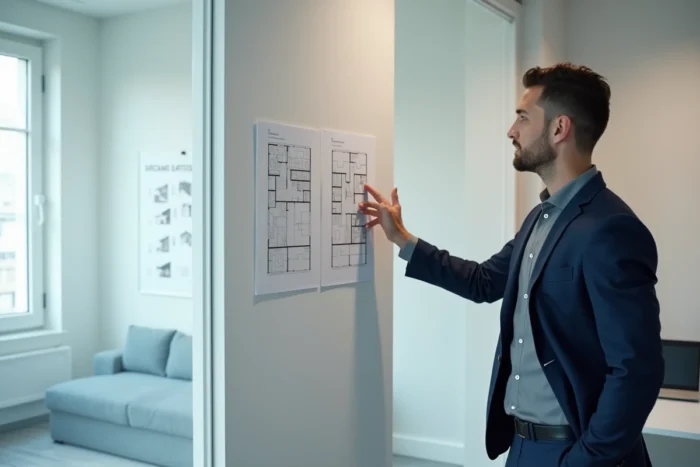
No legal text defines the terms T1, T2 or F1, F2. These are codes of professional practice stabilized in the Francophone sector, not legally enforceable categories. This lack of legal framework has concrete implications.
During a sale, the compromise mentions the Carrez area, not the T or F typology. A seller who advertises a T2 when the second room does not meet the criteria for a main room (minimum area of 9 m², ceiling height of 2.20 m) does not commit an infringement but exposes themselves to a dispute over the property’s value.
In rentals, the CAF and administrations rely on the living area and the number of rooms declared in the lease, not on the commercial designation. A landlord who describes their property as “T1 bis” or “studio bis” in a listing uses a designation that these organizations do not formally recognize.
What the count of main rooms includes and excludes
The number that follows the letter T or F counts only the living spaces:
- The living room (or lounge, or dining room if it is an independent room) is always the first room counted in a T2 or F2
- The bedroom closed by a door represents the second room, provided its area exceeds 9 m² and the ceiling height reaches 2.20 m
- The kitchen, bathroom, toilets, hallways, landings, and closets are never counted, regardless of their area
An apartment with an open kitchen to the living room remains a T2 if the bedroom is separate. The open kitchen does not create an additional room.
T2 bis, studio, T1: frequent confusions in real estate listings
The mention “bis” indicates an additional space (nook, mezzanine, recess) that does not meet the criteria for a main room but offers comparable use. A T2 bis therefore includes two main rooms plus an intermediate space, often a nook in the living room or a convertible corner.
The most common confusion concerns the studio and the T1. The studio combines the living area and kitchen corner into a single volume, with only the bathroom separated. The T1 has a main room and a separate, closed kitchen. A T2, on the other hand, adds a separate bedroom to the living room.
In practice, we recommend never relying solely on the designation in a listing. Always check the plan or detailed description:
- A “large studio” may actually correspond to a T1 if the kitchen is enclosed
- A “T2” whose bedroom measures less than 9 m² should technically be classified as a T1 bis
- A “F3” may turn out to be a T2 with a closed kitchen improperly counted as a third room
Criteria for choosing between T2 and T1 for rental investment
The T2 attracts a more stable tenant profile than the T1 or studio. Couples and young professionals at the start of their careers are the main target, with an average occupancy duration significantly longer than for smaller units.
The yield per square meter of a T2 is generally lower than that of a studio, but the risk of vacancy decreases. Reduced turnover limits refurbishment costs and periods without rent.
The acquisition price of a T2 remains accessible in most secondary markets, making it a preferred format for a first rental investment. Resale targets a broad audience: investors, first-time buyers, couples.
For a primary residence purchase, the T2 is suitable for a single person who wants to separate work and sleeping areas, or for a couple without children. Beyond two occupants, moving to a T3 becomes necessary to meet decency criteria related to space per occupant.
The next time a listing shows “F2” where another indicates “T2,” the useful reflex is not to look for a difference in configuration, but to check the plan, the Carrez area, and compliance with the main room criteria. This is where the reality of the housing lies, not in the choice of a letter.