
Measuring 1m55 when living in France means regularly hearing comments about your height. The looks at the bar counter, the high shelves in the supermarket, the clothes that are too long in stores: these everyday situations remind one of a deviation from the norm. A few figures help to precisely situate this stature.
1m55 and French average: where do we stand exactly
The average height of women in France is 1.64 m according to recent data. A woman who is 1m55 is therefore 9 centimeters below this reference. The gap seems modest on paper, but it is enough to alter social perception.
To better understand what these 9 centimeters represent, one must look at the statistical distribution. The threshold for “short stature” is generally set around 1.54 m, which corresponds to about 10% of the French female population. At 1m55, one is just above this threshold.
In other words, 1m55 is below average without being a rare height. About one in ten women is shorter. It is neither exceptional nor pathological, but it is objectively a short height in the French context.
A guide for a woman 1m55 on Mode by S details the concrete implications of this stature in daily life, from clothing choices to visual proportions.
Global comparison: context changes perception
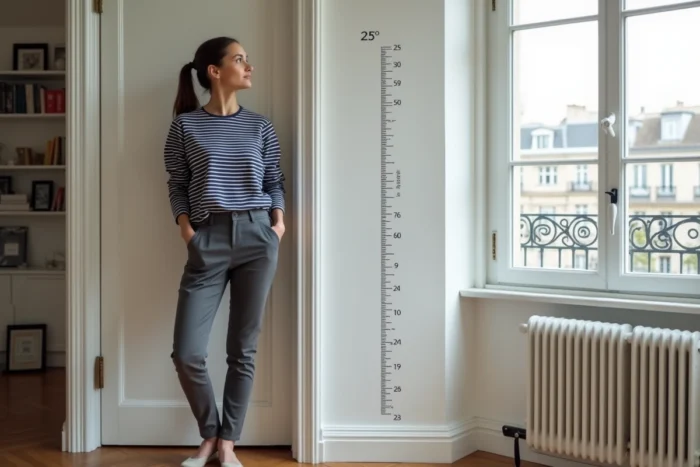
The global average female height is 1.60 m. A French woman of 1m55 is therefore also below this global reference. The gap with the world average remains 5 centimeters, placing this stature among the most modest on an international scale as well.
Have you ever noticed that the perception of height changes depending on the country? In East and Southeast Asia, the average height for women ranges from 1.57 m to 1.60 m. In this context, 1m55 remains slightly below average but goes almost unnoticed.
In Northern Europe, the contrast is much more pronounced. Danish and Estonian women average 1.69 m, which is 14 centimeters taller. In a group of Scandinavian women, a French woman of 1m55 would clearly be identified as short.
This discrepancy between European countries can be explained by genetic and nutritional factors accumulated over several generations. Populations in Northern Europe have historically gained more centimeters than those in the south, a gradient that persists today.
Short stature in women: what the numbers don’t say
The gap from the average only describes part of the experience. Height interacts with other body measurements, and it is this combination that determines how one experiences their body in daily life.
- Proportions matter more than height alone. Two women of 1m55 with different leg or torso lengths will not have the same silhouette or the same clothing constraints at all.
- Body mass index relates weight to the square of height. At the same weight, a woman of 1m55 will have a higher BMI than a woman of 1m64. The thresholds for “normal weight” are therefore narrower for shorter heights.
- Physical comfort in public spaces (transport, furniture, kitchen work surfaces) is calibrated for a height range that often starts above 1m60. Ergonomic adjustments are rarely designed for women below this height.
The relationship to the body also varies according to social characteristics. Social science research on body size in Europe shows that women face greater pressure than men regarding their physical characteristics, and that this pressure varies according to education level and income.
Fashion and height 1m55: the real practical obstacles

Women’s ready-to-wear in France is designed for a reference stature that hovers around 1.65 m to 1.70 m depending on the brands. For a woman of 1m55, this means systematic alterations on pants, midi dresses becoming maxi, and coats with shoulders that drop too low.
The “petite” ranges exist at some retailers, but they remain a minority in the French offering. Most brands offer only one length scale, which forces women under 1m60 to adapt their purchases themselves.
Choosing clothes with adjusted proportions changes the silhouette more than a size choice. Fitted cuts with marked vertical lines, high waists on pants and skirts, or pointed-toe shoes create a visual elongation effect without cheating on actual height.
Why does this detail matter? Because clothing is often the first filter through which height is perceived by others. A well-proportioned garment for a 1m55 morphology does not “look short.” A standard garment worn without adjustment does.
Social perception and self-confidence at 1m55
Height is one of the most commented physical characteristics in social interactions. Short women frequently report unsolicited remarks, often phrased as compliments (“it’s cute, a small woman”) but perceived as infantilizing.
The pressure on physical appearance is not limited to weight: height also generates a gap between the real body and the internalized norm. This phenomenon affects women more strongly than men, regardless of the measured indicator.
At 1m55, one is statistically short in France, that is a fact. The gap with the national average is real, measurable, and has practical consequences on daily life. What is a matter of choice, however, is the importance we give to this number in our self-image.