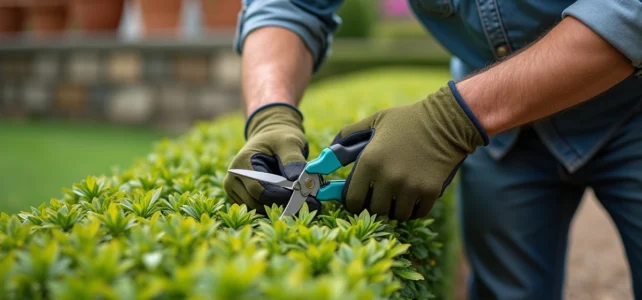
The size of a hedge is not limited to shortening branches. It is an intervention that modifies the distribution of light within the plant, directs the growth of the shoots, and determines the density of the foliage over several seasons. Pruning at the wrong time or in the wrong direction results in hedges that are bare at the base, browned on the surface, and sometimes permanently unbalanced.
Trapezoidal cutting profile: the technical basis that most gardeners ignore
A hedge trimmed perfectly vertical on its sides eventually becomes bare at its lower part. The reason is simple: the top, wider or equal to the base, captures the majority of the light and deprives the lower branches of photosynthesis.
The trapezoidal profile, wider at the bottom than at the top, corrects this problem. By slightly angling the sides inward (a few degrees are sufficient), light reaches the entire height of the plant. The foliage remains dense down to the ground, and the hedge better withstands the weight of snow or rain.
To achieve this regular profile, planting two stakes connected by a line at each end of the hedge remains the most reliable method. The line marks the cutting line and prevents unintentional undulations. Specialized resources like sculpte-haie.com detail the tools suitable for this type of precision work.
Hedge trimming schedule: adapting frequency to the species
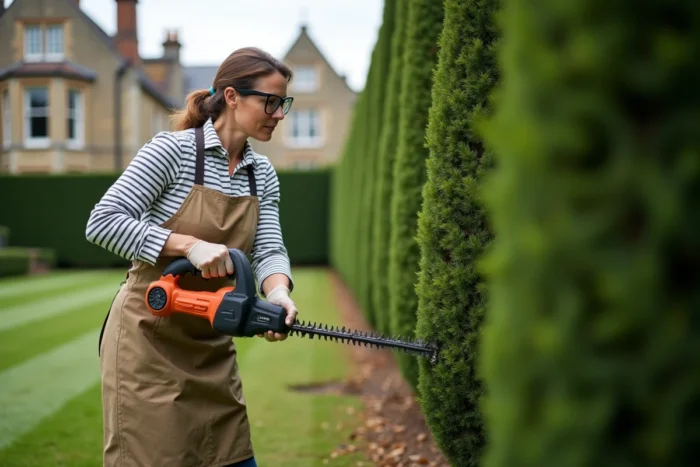
Not all hedges are trimmed at the same rate. A fast-growing single-species hedge (privet, thuja, laurel) requires at least two interventions per year. A wild hedge composed of several species with a free growth habit can tolerate a single trim, or even none in certain years.
Strict single-species hedges
The first trim occurs at the end of spring, after the main growth. The second is done at the end of summer or early autumn, before the vegetation slows down. Trimming between March and August requires vigilance regarding nesting: many birds nest in hedges, and several local regulations prohibit or discourage trimming during this period to preserve biodiversity.
Wild and flowering hedges
Hedges composed of spring-flowering shrubs (forsythia, spiraea, deutzia) are trimmed after flowering, never before. Cutting in winter would remove already formed flower buds. For species that bloom on the wood of the year (buddleia, hibiscus), a trim at the end of winter stimulates flower production.
The wild hedge requires a gentler trim, respecting the natural growth habit of each shrub. Trying to impose a strict geometric shape goes against its landscaping and ecological purpose.
Renewing a bare hedge: the step-by-step method over several seasons
Faced with an old, sparse, or bare hedge at the base, the temptation to cut everything back at once is strong. This approach works on some vigorous species (hornbeam, hazel), but it can kill a thuja or a Leyland cypress, which cannot regrow from old wood.
The safest technique is to renew the hedge over two to three seasons. In the first year, severely cut back one side while leaving the other intact. In the second year, once the trimmed side has regrown, intervene on the opposite side. The top can be gradually lowered in parallel.
This method preserves enough leaf surface for the plant to continue photosynthesizing normally while forcing the development of new shoots where the wood was bare.
Trimming tools: choose based on the diameter of the branches
The choice of tool does not depend on the size of the hedge, but on the diameter of the branches to be cut. Using an electric hedge trimmer on branches that are too thick produces splintered cuts that heal poorly and promote fungal diseases.
- The pruner is suitable for thin branches, up to about one centimeter. It allows for clean cuts on young shoots and finishing work in topiary.
- The hedge trimmer (electric, gas, or battery-powered) effectively handles small diameter branches over large areas. Its blade must remain sharp to avoid shredding the wood.
- The lopper or heavy-duty pruner takes over on thicker woody branches, typical of old hedges or species with hard wood like boxwood or holly.
- The pruning saw is used only for rejuvenation cuts on large wood, beyond a few centimeters in diameter.
Disinfecting the blades with alcohol between each hedge (or between each plant if a disease is suspected) limits the spread of pathogens like canker or boxwood blight.
Topiary sculpture: from boxwood balls to complex shapes
Topiary art consists of sculpting a plant into a geometric or figurative shape. Boxwood remains the reference species for this exercise, thanks to its fine, dense foliage and its ability to withstand repeated trims. Yew and privet are solid alternatives.
For a simple shape (ball, cone, cube), the work is done by eye with a pruner or a lightweight hedge trimmer, regularly turning around the subject to check symmetry. Complex shapes (spiral, animal) require a wire template fixed around the plant, which serves as a cutting guide.
Three to four passes per year are necessary to maintain a neat topiary. Each intervention removes little material, preserving the vigor of the plant while gradually refining the silhouette.
The choice of species determines success: a shrub with large leaves (cherry laurel, photinia) will never yield as precise a result as boxwood or yew. The fineness of the foliage determines the level of detail achievable.
Trimming and sculpting hedges rely on a few stable mechanical and botanical principles: respect the trapezoidal profile, adapt the schedule to the species, graduate the intensity of rejuvenation, and choose the tool based on the wood. A well-managed hedge from the first years requires less corrective work than a neglected hedge that is then hurriedly restored.