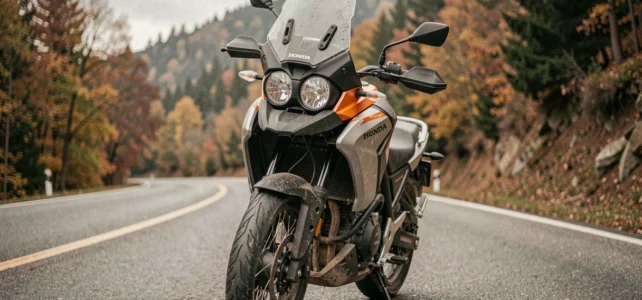
The Honda CB500X is one of those motorcycles that doesn’t create love at first sight. Its 471 cm³ twin-cylinder engine doesn’t promise thrills or power records. However, it’s over time, after several thousand kilometers in varied conditions, that this machine reveals its true strengths and limits.
471 cm³ Engine of the CB500X: How Flexibility Changes Daily Riding
The parallel twin of the CB500X develops about 47.6 hp at 8,500 rpm, right on the limit for the A2 license. On paper, nothing spectacular. In practice, the very smooth power curve changes everything.
Have you ever noticed that in the city, some motorcycles require constant gear shifting? The CB500X avoids this problem. Its engine is willing to run at low revs without complaint, with no jerks or annoying vibrations. In third gear at low speed in residential areas, it remains flexible and docile.
On the road, between 4,000 and 6,500 rpm, the available torque is sufficient for overtaking without downshifting. The six-speed gearbox is just right: the intervals between gears are short, making transitions easier. Feedback from users who have traveled very long distances confirms this mechanical consistency. The engine doesn’t tire, and neither does the rider.
A notable point: the engine is now Euro 5+ compliant on the successor NX500, without major modifications to its character or power.
For those interested in the behavior and consumption of the Honda CB500X, the linearity of this engine is the first factor to understand: it conditions both riding comfort and fuel economy.

Real Consumption of the Honda CB500X: City, Road, and Highway
Manufacturer data always presents a flattering image. What matters is the consumption observed after months of mixed use.
In urban use, the CB500X remains remarkably economical. The engine’s flexibility at low revs limits unnecessary revs, which directly translates to the pump. On national and departmental roads, efficiency improves even more: the cruising speed remains moderate, and the motorcycle doesn’t need to be pushed to maintain a smooth pace.
The highway is the least favorable terrain. Beyond 120 km/h, the twin runs noticeably higher, and consumption increases. The aerodynamic protection, adequate for a road-oriented trail of this size, does not prevent wind resistance from increasing fuel costs on long highway trips.
Factors Influencing Daily Consumption
- Riding style weighs more than the type of road: sharp accelerations and late braking in the city significantly degrade the balance, while anticipatory riding maintains remarkable economy.
- The weight carried (passenger, luggage, equipment) changes the equation. Loaded for a trip, the CB500X consumes noticeably more, especially in hilly terrain.
- Tire pressure, often neglected, plays a direct role. Tires under-inflated by a few tenths increase rolling resistance and thus consumption.
Road Behavior of the CB500X: Chassis and Riding Position
The CB500X is neither a roadster nor a pure trail bike. Its inverted fork, 19-inch front wheel, and frame geometry place it in a category of its own: that of a versatile road trail, stable without being clumsy.
In corners, the motorcycle positions itself easily. The contained weight facilitates angle changes, even at low speeds in roundabouts. The fork offers a good compromise between absorbing irregularities and cornering stability. On degraded surfaces, the feedback to the handlebars remains readable without being harsh.
The riding position is upright, slightly forward. The seat, at a moderate height, allows average-sized riders to place their feet flat. This detail matters greatly over time: after several hours on the road, the absence of tension in the wrists and lower back makes a difference.
Braking and Active Safety
The braking relies on a front disc of adequate size for the category, assisted by ABS. The feel at the lever is progressive, without a threshold effect. The rear brake, often underused by beginners, complements the overall braking during firm stops.
A point to note: on wet surfaces or gravel, the ABS intervenes early but without harshness. For a motorcycle accessible to A2 license holders, this reassuring ABS calibration enhances confidence in degraded conditions.
CB500X vs. NX500: Continuity or Break for Honda
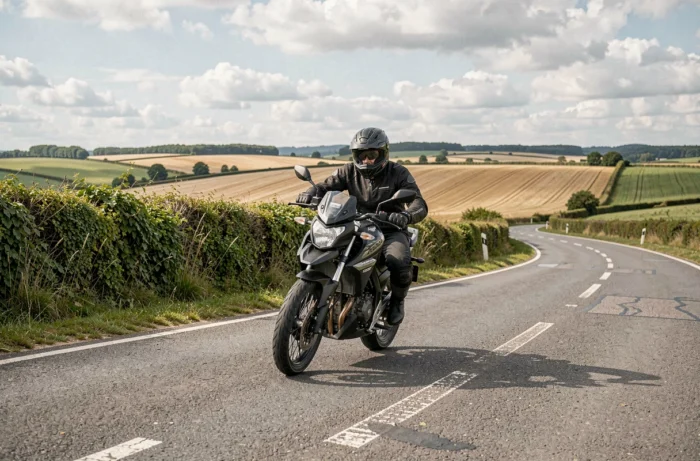
Since 2024, Honda is gradually replacing the CB500X with the NX500. The name changes, the positioning evolves slightly, but the essence remains the same. The 471 cm³ engine is retained, the frame geometry is not significantly altered, and the concept remains that of a road trail rather than an off-road bike.
Honda has not adopted 21/18-inch spoked wheels, nor significantly raised the ground clearance. The NX500 confirms the philosophy of the CB500X: a motorcycle designed for the road, capable of venturing onto a dirt track, but not intended for serious off-road use.
For current CB500X owners, this means that parts, mechanical knowledge, and feedback remain largely transferable. The motorcycle ages well because Honda has not tried to make it something other than what it is.
The CB500X does not seek to impress. It rides, it consumes little, it forgives riding inaccuracies. Over several thousand kilometers, it is precisely this absence of unpleasant surprises that ultimately constitutes its main argument.