
The term “cosmic unicorn” refers, in astrophysics, to a celestial object whose properties do not fit any known category. For several months now, this expression has also migrated into popular culture, where it fuels a visual and commercial universe blending fairy tales and astronomy. This dual identity, between recent scientific discoveries and creative variations, touches fashion, decoration, and the collective imagination.
Long-period radio transients: the physics behind the nickname
Before discussing trends or merchandise, it is essential to understand why astronomers used the word “unicorn.” The object named CHIME J1634+44, detected by a team from the Green Bank Observatory, belongs to a poorly defined class: long-period radio transients. These are dead stars in rotation that emit radio waves at irregular intervals, on cycles ranging from a few minutes to several hours.
What makes this object unique is the combination of characteristics that are normally incompatible. Its mass is comparable to that of the Sun, but compressed into an infinitesimal volume. Its rotation accelerates, unlike classical dead stars whose rotation slows down, while producing radio signals whose pattern corresponds neither to a standard pulsar nor to a cataloged magnetar.
The news from the Licorne Cosmique website allows following these astrophysical advancements through scientific publications.

The hypotheses range from a neutron star with an extreme magnetic field to a magnetic white dwarf. None account for all observations. It is precisely this unclassifiable nature that earned the object its nickname of cosmic unicorn: a celestial body that exists but current models struggle to explain.
Magnetars and vacuum birefringence: a natural quantum laboratory
The discovery of CHIME J1634+44 is part of a broader research trend. Ultra-magnetic neutron stars, or magnetars, now serve as testbeds for fundamental physics. Recent studies report direct evidence of vacuum birefringence, a quantum effect predicted nearly 90 years ago, observed through the polarization of X-rays emitted by a magnetar.
Vacuum birefringence suggests that the vacuum itself, subjected to a sufficiently intense magnetic field, behaves like an optical crystal and deflects light differently depending on its polarization. This phenomenon, long theoretical, finds in magnetars a natural environment where magnetic field conditions reach levels impossible to replicate in terrestrial laboratories.
This link between “unicorn” objects and quantum physics in extreme conditions adds further depth to the term. The cosmic unicorn is not just an astronomical curiosity: it opens a window onto physical laws that are still partially verified.
Black hole star: a new hybrid object in the distant Universe
Another recent discovery that extends the notion of the cosmic unicorn: an object observed in the distant Universe that combines the appearance of a massive star, wrapped in a hydrogen cocoon comparable in size to the Solar System, with an energy output typical of a black hole. The authors of this observation propose that it represents an early phase of supermassive black hole formation.
This type of hybrid object blurs the boundaries between stellar categories. It joins the growing family of “impossible” discoveries that force astrophysicists to revise their models of cosmic structure formation and evolution.
The common thread among these discoveries lies in their detection method. Infrared observation, combined with the analysis of radio waves and X-rays, allows for the characterization of objects that visible light alone cannot identify. Next-generation telescopes, capable of simultaneously covering multiple wavelengths, increase the chances of spotting these anomalies.
Unicorn constellation and associated nebulae: mapping an unknown region
The word “unicorn” in astronomy is not new as of 2025. The Unicorn constellation (Monoceros) occupies a discreet area of the celestial equator, overshadowed by its neighbor Orion. However, it houses remarkable objects:
- The Rosette Nebula, a vast region of young star formation, visible in infrared as a cloud of gas and dust traversed by a central star cluster.
This constellation offers a rich observation ground for astrophotographers. The density of nebulae and clusters in this region makes it a popular subject during long-exposure imaging campaigns.
Cosmic unicorn in culture: exhibitions and visual trends
The shift of the term “cosmic unicorn” into popular culture is accelerating. In France, several exhibitions dedicated to fantastic creatures now incorporate an astronomical aspect, linking the mythological figure of the unicorn to its celestial counterparts. The Cluny Museum in Paris, which houses the famous tapestry of The Lady and the Unicorn, attracts a renewed audience through this dual reading.
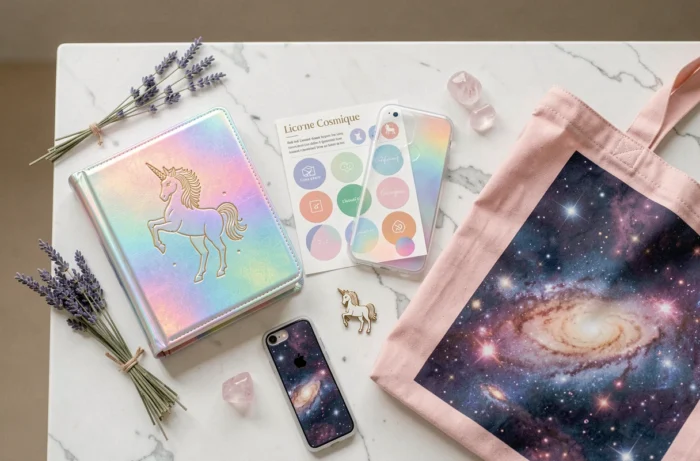
In terms of visual trends, the “cosmic unicorn” aesthetic blends pastel palettes, galactic patterns, and references to nebulae. This imagery permeates children’s fashion, interior decoration, and creative supplies, with a notable upgrade compared to purely rainbow products from previous years.
- Clothing and accessories incorporate prints inspired by actual telescope images (colored gas clouds, star fields).
- Bedroom decor adopts chromatic codes derived from the Rosette Nebula.
- Everyday objects (stationery, textiles) favor holographic finishes that evoke the diffraction of starlight.
The Licorne Cosmique universe stands out from classic unicorn trends due to this scientific anchor. The aesthetic is not based solely on fantasy but on documented astronomical phenomena, which gives it a more sustainable visual and narrative coherence.
The next step for this universe could come from data from the James Webb Space Telescope, whose deep infrared images regularly provide new spectacular visuals. Each NASA publication generates a wave of creative variations, and the recently discovered hybrid objects offer a reservoir of inspiration that previous collections had not tapped into.