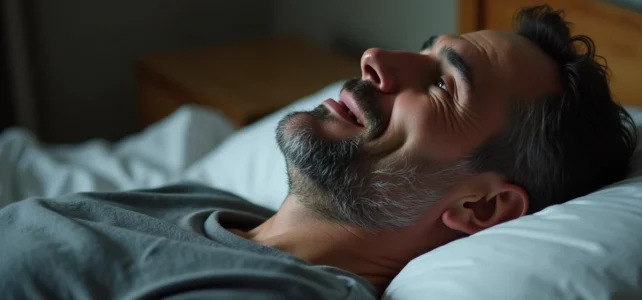
We sleep next to someone who snores, or we wake up with a dry throat and the feeling of not having recovered. In both cases, snoring poses a concrete problem long before we put a medical name to it.
Snoring results from the vibration of the soft tissues in the upper airways (soft palate, uvula, base of the tongue) when the airflow passage narrows during sleep. Understanding why this narrowing occurs in you, and not in your roommate, changes everything in choosing a solution.
Snoring and nocturnal hypertension: an underestimated signal
Most content on snoring stops at the noise nuisance and the partner’s fatigue. We overlook a more serious health point: snoring can be a marker of undiagnosed nocturnal hypertension. Blood pressure that remains high at night is not detected during a regular daytime consultation. It requires 24-hour monitoring.
When one snores chronically and experiences morning headaches, marked daytime sleepiness, and irritability, we are no longer talking about a simple unpleasant noise. We are facing a clinical profile that justifies a consultation. The breathing pauses observed by the partner complete this picture and point towards a possible sleep apnea syndrome.
To learn everything about snoring with Toujours Le Bon Choix, this link between chronic snoring and cardiovascular risk deserves to be taken seriously before looking for an anti-snoring gadget.
Mechanical causes of snoring: the hierarchy that matters on the ground
Before ordering a device online, it’s worthwhile to identify the dominant cause. Recent sources converge on a practical logic: start with behavioral factors, then move up to anatomical causes if nothing changes.

Behavioral factors to check first
- Overweight remains the primary aggravating factor. Fat accumulated around the neck and throat reduces the diameter of the airways, even in a lateral position.
- Alcohol consumed in the evening relaxes the throat muscles well beyond the natural relaxation of sleep. Eliminating alcohol three hours before bedtime often yields visible results from the first night.
- Tobacco causes chronic inflammation of the nasal mucosa and palate, worsening obstruction. The effect persists even in moderate smokers.
- Sleeping on your back encourages the tongue to fall back towards the throat. Sleeping on your side, sometimes aided by a positional pillow, limits this phenomenon.
Anatomical causes to explore next
Once habits have been corrected and snoring persists, we move to the ENT aspect. A deviated septum, polyps, an overly long soft palate, or enlarged tonsils create a mechanical obstruction that lifestyle changes alone cannot resolve. An examination by an ENT doctor allows for precise localization of the narrowing point.
This hierarchy is not theoretical. It prevents spending money on a nasal spray when the real problem comes from being overweight, or from insisting on a diet when a septal deviation blocks nasal breathing.
Anti-snoring devices: real effectiveness and lifespan
“Consumer” solutions against snoring have never been more visible in pharmacies and online. Sprays, nasal strips, mandibular advancement devices, ergonomic pillows: the range is wide. Their effectiveness remains highly variable depending on the exact cause of the snoring.
Mandibular device and custom mouthguard
The mandibular advancement device slightly moves the lower jaw forward during sleep to clear the airway at the throat level. It is the best-documented solution for snoring related to tongue retraction. A custom-made mouthguard from a trained dentist offers more stable support than a thermoplastic model purchased at a pharmacy.
Feedback varies on this point: some users report an initial positive effect that diminishes after a few months. A TF1 report highlights that users notice a loss of effectiveness over time, raising the question of regular follow-up and adjustment of the device.
Sprays and nasal strips
These products target nasal congestion. If your snoring comes from a nasal obstruction (allergic rhinitis, mild polyps), an essential oil-based spray or a strip can improve airflow. If the problem lies at the level of the palate or throat, these solutions will have only a marginal effect.

When to consult a doctor for chronic snoring
We do not consult just because we snore. We consult because snoring is accompanied by specific signals that form a risk profile.
- Breathing pauses observed by the partner during the night
- Recurring headaches upon waking without another identified cause
- Excessive daytime sleepiness despite normal sleep duration
- Unusual irritability or concentration difficulties
This profile points towards a suspicion of sleep apnea. The doctor then prescribes a nocturnal ventilatory polygraphy (an examination that can be done at home) to measure respiratory events during the night. If the diagnosis is confirmed, management can range from continuous positive airway pressure (CPAP) devices to ENT surgery, depending on severity and cause.
A progressively worsening snoring should not be trivialized, even if one lives alone and no one complains. Chronic fatigue and the associated cardiovascular risk alone justify a medical assessment, regardless of the noise.