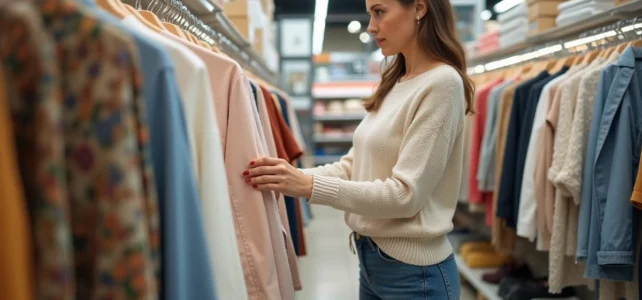
The textile department of large and medium-sized stores (GMS) remains a blind spot in fashion analysis. Intermarché’s women’s offering illustrates a shift in materials and manufacturing that deserves a technical examination, particularly through the upgrading of private label textile brands.
Organic Cotton and Linen in GMS: A Change in Textile Specifications
The shift towards organic cotton for basics (T-shirts, tops, lightweight dresses) changes the game in terms of wash durability. Organic cotton grown without synthetic pesticides retains longer fibers, which reduces pilling and limits shrinkage after several machine washes.
We also observe the introduction of linen pieces in summer collections. Linen, a naturally abrasion-resistant fiber, withstands repeated washing well without losing its structure. For a piece sold in a supermarket at a reasonable price, this material choice measurably extends the garment’s lifespan.
This material repositioning contrasts with the usual logic of GMS textiles, which has long been confined to low-quality polyester and conventional short-fiber cotton. When analyzing women’s clothing at Intermarché from this perspective, the shift towards natural fibers with better longevity appears as a deliberate technical choice, not a superficial marketing argument.
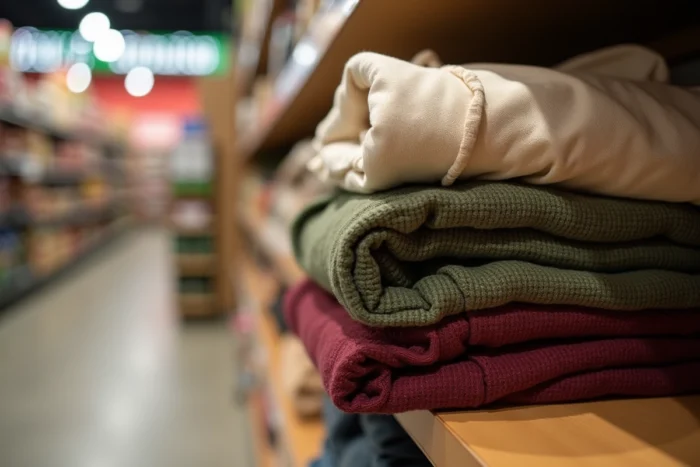
Textile Quality in Supermarkets: Key Control Points to Check
The raw material is not everything. Poorly assembled organic cotton remains a fragile garment. We recommend systematically checking three elements before purchase, even in GMS.
- Reinforcement seams at stress points (armholes, neckline, hem): a double stitch or a clean overlock indicates a level of construction superior to the industrial minimum
- The fabric density to the touch: a jersey that is too thin allows light to pass through when stretched, indicating an insufficient weight to last more than a few washes
- The symmetry of patterns at seam junctions: a print that does not align with side seams betrays a mass-produced cut, without attention to pattern placement
These checks take less than a minute in the aisle. They allow one to distinguish, within the same brand, the truly durable pieces from the fast-turnover promotional products.
The Composition Label: An Underutilized Indicator
A percentage of elastane greater than 5% weakens durability over time. Beyond this threshold, the fabric gradually loses its elasticity with each wash, which distorts the neckline and cuffs. The best pieces in the women’s section limit elastane to the strict minimum necessary for comfort, generally around 2 to 3%.
The mention of “organic cotton” or “linen” in the first position on the label means that this fiber represents the majority share of the blend. This is a reliable benchmark for quickly assessing the intrinsic quality of an item.
Traceability and French Origin: The GMS Strategy Applied to Textiles
Intermarché applies to textiles a logic already established in food: promoting local origin as proof of traceability. This approach, documented on fresh products and regional supply chains, is beginning to influence decisions on private label textile collections.
A shorter textile supply chain allows for better quality control at every stage. When knitting, dyeing, and manufacturing remain within a limited geographical area, feedback on manufacturing defects is relayed more quickly. Corrections can be made from one season to the next, sometimes from one restock to another.

This regionalization of textile sourcing in GMS is not trivial. It also reduces transportation footprint and simplifies compliance with European standards (REACH, in particular), as local suppliers already operate within the regulatory framework.
The Role of Private Labels in Accessing More Sustainable Fashion
The private label textile brand occupies a niche that neither fast fashion nor premium brands truly cover. A well-sourced private label garment offers a sustainability-price ratio that is hard to match in the women’s basics segment (plain T-shirts, pants, simple dresses).
The absence of a heavy marketing budget and a network of owned stores allows for reallocating a portion of the selling price to material quality. This is a structural trade-off that fast fashion brands cannot replicate, as their economic model relies on volume and ultra-rapid collection turnover.
Textile Care: What Really Prolongs Lifespan
Buying a piece made of organic cotton or linen guarantees nothing if the care is inadequate. A few practices make a measurable difference in longevity.
- Wash at a maximum of 30 °C for natural fibers: each additional degree accelerates fiber degradation and color fading
- Turn garments inside out before washing to protect the visible side from drum abrasion
- Avoid tumble drying linen pieces, which retain their structure better when air-dried
- Space out washes when the garment is not visibly dirty: an organic cotton T-shirt worn for a few hours can be aired out rather than washed
Proper care can double the lifespan of a basic garment. This is a parameter that the purchase price never reflects, but which determines the real cost per use.
The women’s textile offering in GMS is evolving faster than its reputation. Brands that invest in material quality, traceability, and demanding specifications are gradually changing the game. The clothing section of an Intermarché no longer resembles what it offered a few years ago, and the fibers, seams, and labels confirm this with every visit to the aisle.