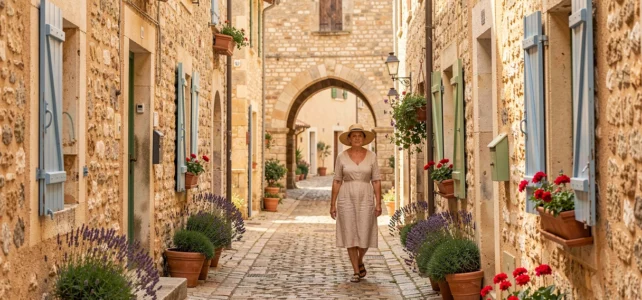
Robion stands out from the showcase villages of the Luberon due to a rarely documented layering of built environments. The current town, spread out at the foot of the hills between the Cavaillon plain and the first limestone reliefs, coexists with an abandoned perched site that most tourist guides barely mention. It is this duality that structures the territory and gives it a heritage interest far beyond the picturesque Provençal.
Old Robion: reading an abandoned perched village in the Luberon
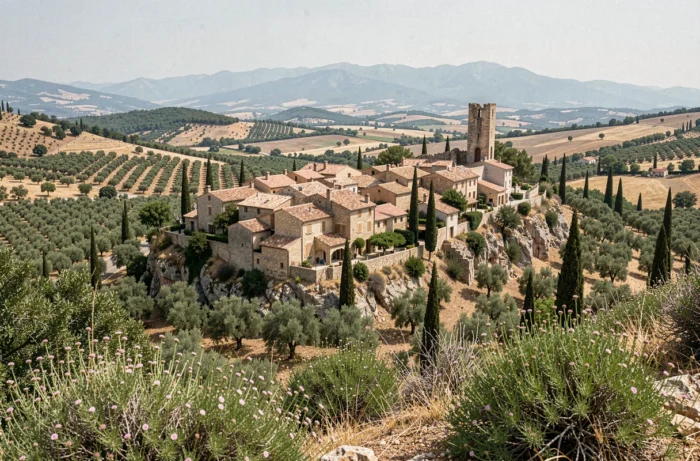
The old Robion is an abandoned perched village on a distinct limestone rock from the inhabited town. This type of deserted castle site, common in Provence, takes on a particularly legible form here: the isolated rock still bears traces of a compact medieval habitat, with remnants of enclosing walls and terraces.
We recommend approaching the old village via the path that starts from the current town. The short ascent allows for a cross-section view of the local geology: fractured Urgonian limestone, thin soils colonized by garrigue. The contrast with the agricultural plain below is striking.
This site has not been subjected to heavy tourist development, making it all the more interesting for those interested in vernacular heritage. In Robion, the coexistence between the living village and its abandoned counterpart tells the story of the descent of perched habitats to the plain better than any sign could, a classic phenomenon in Vaucluse between the 16th and 18th centuries.
AOC Luberon and vineyards around Robion: an underestimated terroir
Tourist content about Robion systematically overlooks the vineyard. The AOC Luberon covers a structured wine-growing territory that extends across the massif, and Robion is located within its direct influence zone, between Cavaillon and the Calavon valley.
This appellation produces reds, rosés, and whites that are increasingly appealing to sommeliers. The positioning is that of an accessible wine-growing Luberon, away from the land speculation affecting neighboring appellations like Ventoux or Châteauneuf-du-Pape.
For a stay in Robion, we recommend combining the discovery of the village with a tour of the wineries. Several estates are accessible by bike from the town, via the Calavon bike route. This is an angle of visit that institutional pages do not exploit, even though it corresponds to a real demand from visitors seeking terroir experiences.
What the vineyard brings to the landscape reading
The vineyard plots visually structure the northern foothills of the Luberon. From the heights of old Robion, one can distinguish the mosaic of crops: vines, olive trees, cherry trees, market gardening. This active agricultural landscape differentiates Robion from the museum-like villages of central Luberon such as Gordes or Ménerbes, where residential function has largely supplanted agriculture.
Motoball in Robion: a marker of Provençal local life
Motoball does not appear in any tourist guide about the Luberon. Yet, it is a team sport practiced in Robion with a team competing at the national level. The regional press regularly covers the matches of the Robion team in Élite 1.
Motoball is a more reliable indicator of village sociability than a Provençal market or a summer festival. It implies a structured club, volunteers, a field, and a community of supporters. For a visitor seeking to understand what makes a Provençal village thrive beyond the scenery, it is a relevant entry point.
This spectacular sport (football on motorcycles, in summary) is played outdoors and matches are open to the public. If you stay in Robion during the season, we recommend checking the match schedule.
Stay in a house or farmhouse near Robion: what the demand reveals
The holiday rental offers around Robion confirm a specific stay profile. The demand focuses on houses or farmhouses with gardens, pools, or jacuzzis, in a calm countryside setting. This is not a perched village tourism or cultural circuit, but residential proximity tourism focused on relaxation.
This rental reality distinguishes Robion from its more media-covered neighbors. Gordes or Bonnieux attract passing tourism (day visits, photos, restaurants). Robion captures an audience that stays several nights and uses the village as a base to explore the Luberon.
- Quick access to Cavaillon for shopping and markets, with a bus connection via line 907 of the Zou network
- Proximity to the Calavon bike route for daily outings without a car
- Position on the edge of the Luberon Regional Natural Park, with hiking departures directly from the village
- Residential calm that classified villages can no longer offer in high season
Built heritage of the current village
The town of Robion retains a 12th-century Romanesque church of Notre-Dame-de-la-Nativité, cobbled streets, and a monumental fountain. The open-air theater, set in a wooded area, hosts performances during the summer season. The chapel of the Pénitents-Blancs completes a modest but coherent heritage ensemble.
These elements can be visited in one to two hours. The interest lies not in the monumentality (Robion is nothing like Gordes) but in the legibility of a Provençal village that has retained its scale and residential function without tipping into total tourism.
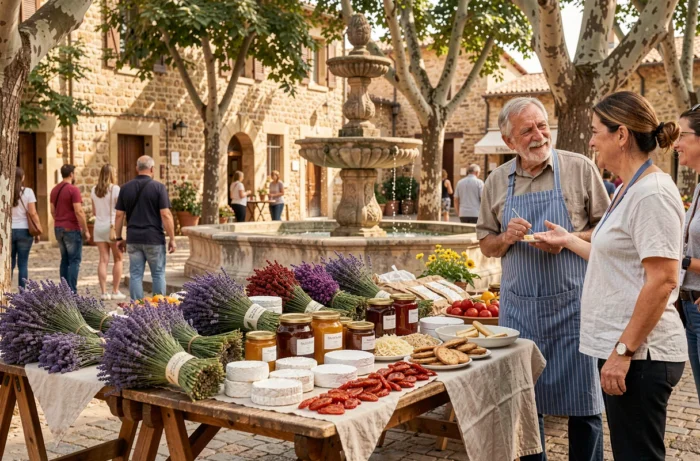
Robion remains a village where people live before being a village that one visits. The Provençal market on Thursday mornings, the motoball team, the active vineyard, the year-round inhabited farmhouses: each element refers to a functional territory rather than a backdrop. This is precisely what makes it a more interesting base for a stay than the neighboring communes saturated in high season.