
When a chain restaurant closes its doors, it’s not just a logo that disappears from a roundabout. It’s a business model, a type of standardized cuisine, and sometimes a territorial landmark that fades away. In France, several historic brands of sit-down dining have faced major difficulties in recent years, leading to collective proceedings affecting dozens of locations simultaneously.
Judicial recovery of the Baudaire group: an entire portfolio of struggling brands
The most revealing case of the structural fragility of restaurant chains in France is that of the Baudaire group. This group, which operates or franchises brands like Courtepaille, La Boucherie, Poivre Rouge, Bistrot du Boucher, and KdB Bistrot, entered into judicial recovery at the end of June 2024 before the commercial court of Angers.
The procedure concerns approximately 180 restaurants, including more than 90 Courtepaille. This is not the fall of an isolated brand. It’s a complete portfolio of brands, often located on roadways and on the outskirts of cities, that is plunging into legal and financial uncertainty at the same time.
For franchisees, the situation poses a concrete problem: their business depends on a network whose head is wobbling. For the affected territories, these restaurants formed an almost institutional network, sometimes the only sit-down dining option in certain commercial areas. The story of the restaurant chains that have disappeared in France shows that this type of collective collapse is not new, but its current scale marks a turning point.
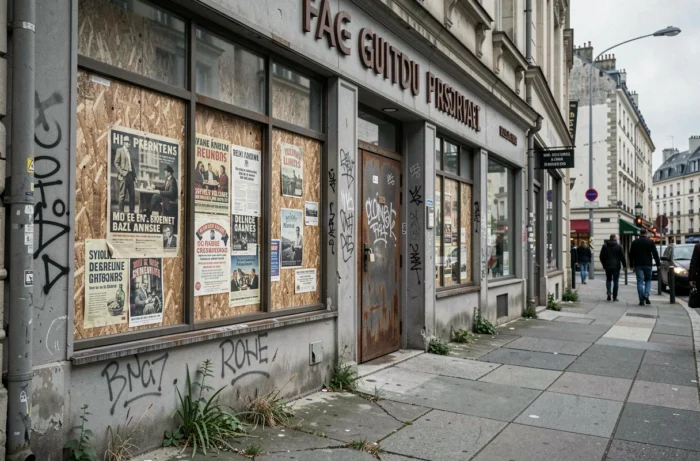
Flunch closures: the end of a popular dining model
Flunch, launched in 1971 and franchised from 1999, represented a unique concept in the French landscape: family self-service at moderate prices, linked to shopping centers. The brand has experienced a wave of closures that has significantly reduced its network.
The phenomenon is not due to a single factor. The rise in operating costs and the decline in foot traffic at shopping centers have weighed heavily. Eating habits have also evolved: the family clientele that formed the backbone of Flunch has partially shifted towards delivery or to fast food formats perceived as more modern.
What remains of Flunch after these closures is an ambiguous legacy. The French-style self-service model has not really been taken up by other brands. It has simply faded away in most medium-sized cities where it operated, without being replaced by an equivalent.
Chains that have disappeared in France: a table of historic brands and their trajectories
| Brand | Creation | Franchising | Recent Situation |
|---|---|---|---|
| Courtepaille | 1961 | 1961 | Judicial recovery (Baudaire group, 2024) |
| Hippopotamus | 1968 | 1988 | Significantly reduced network |
| Flunch | 1971 | 1999 | Wave of closures, residual network |
| Wimpy | Imported 1970s | – | Disappeared from the French market |
| Buffalo Grill | 1980 | 1984 | Active, but undergoing successive restructurings |
| Pomme de Pain | 1980 | 2007 | Reduced network |
This table illustrates a recurring pattern: brands born between 1960 and 1980 are the most exposed. Their model relied on low real estate prices on the outskirts, a captive clientele on roadways, and a contained average ticket. All three pillars have weakened.
Why chains from the 1960s-1980s are the most vulnerable
Location on the roadside or in commercial areas assumed a constant flow of motorized customers. The rise of telecommuting and the reduction of business travel have diminished this flow. At the same time, commercial rents on the outskirts have increased without corresponding sales growth.
The “grill-fry” or “buffet” format, which was the strength of these brands, has failed to renew itself in the face of the rise of food court concepts, quick Asian cuisine, or premium burgers. The average price positioning without culinary differentiation has become the most difficult segment to defend.

Culinary legacy of the disappeared chains: what remains in French cuisine
The disappearance of a chain does not mean the disappearance of its influence. Courtepaille popularized wood-fired grilling in commercial dining. Flunch normalized the idea that a family could eat at a restaurant for a modest price, without reservations or dress codes. Hippopotamus helped establish red meat as a draw in sit-down dining.
These contributions are now found in different formats. Independent steakhouses carry on the legacy of Buffalo Grill and Hippopotamus. Urban canteens extend the spirit of Flunch’s self-service, but with a shorter menu and a focus on local products.
- Wood-fired grilling, popularized by Courtepaille, remains a selling point in peripheral dining
- The all-you-can-eat buffet, inherited from Flunch, survives in Asian restaurants and brunch offerings
- Steak and fries as a signature dish, established by Hippopotamus, remains the most ordered dish in traditional brasseries in France
The title of master restaurateur as a response to standardization
In the face of the disappearance of chains, the title of master restaurateur has gained visibility. This label distinguishes establishments that cook on-site from raw products. It represents a direct counter-model to the assembly-line cooking that characterized most of the disappeared chains.
The conditions for granting this title have recently evolved to strengthen transparency requirements towards consumers. This evolution reflects a demand: after decades of standardized dining, part of the French clientele seeks to know what they are eating and who is preparing it.
The wave of closures affecting chain dining in France is not a conjunctural accident linked to a single crisis. It is the consequence of a business model designed for a suburban France of the 1970s, facing costs, expectations, and eating habits that have profoundly changed. The brands that survive are those that have managed to modify their menu, format, or location. The others leave behind a diffuse culinary legacy, absorbed by independent dining.